Why Your Baseline Schedule Gets Rejected — and How to Get It Approved on the First Submission
A planner's field guide to the twelve reasons owners and engineers send baselines back, the automated checks they now run before a human even opens your file, and the submission routine that gets programmes accepted in 2026.
By Dr. Hassan Eliwa, PhD — Founder of PMMilestone.org & PMMilestone.com · 2026-11-24
Why Your Baseline Schedule Gets Rejected — and How to Get It Approved on the First Submission
By Dr. Hassan Eliwa, PhD — Founder of PMMilestone.org & PMMilestone.com · Updated 2026-11-24 · https://pmmilestone.com/career-guides/baseline-schedule-rejected-how-to-get-approved
The email every planner dreads
It usually arrives on a Thursday afternoon. The subject line reads something like "Baseline Programme Rev 0 — Status C: Revise and Resubmit." Attached is a comment sheet with forty-three lines, a PDF of the owner's schedule-analysis report covered in red, and a polite paragraph reminding you that interim payments are linked to an accepted programme.
I have been on both sides of that email. Early in my career I received more of them than I care to count. Later, sitting on the owner's side as a project controls lead, I wrote them. What I learned from both chairs is simple and slightly uncomfortable: most baselines are not rejected because the planner is weak. They are rejected because the planner built a schedule for the software, not for the reviewer.
This guide is about closing that gap. It covers what reviewers actually look for, the automated checks that now screen your file before a human reads it, and the submission routine I have used to get baselines accepted at Rev 0 or Rev 1 on building, infrastructure and EPC work.
Why baseline rejections are rising in 2026
Ten years ago, a baseline review meant a senior planner on the engineer's team opening your XER, scrolling through the Gantt chart and writing comments by hand. That still happens. But the first pass is now increasingly automated.
Owners and PMCs routinely run submissions through schedule-quality tools — DCMA 14-point style checks, Acumen Fuse, Nodes & Links, SmartPM and, more recently, AI assistants that read the XER and write a first-draft comment sheet in minutes. Industry bodies such as the APM and consulting firms like McKinsey have been talking about AI-enabled project controls for two years now, and on the ground it shows up first in schedule review.
The practical effect for you as the contractor's planner:
- 🔍 Every logic gap is found. A reviewer used to miss an open end on activity 2,400 of 3,100. A script never does.
- ⏱️ Rejections come faster. Some owners now return a quality-gate failure within 48 hours, before the substantive review even begins.
- 📊 Metrics replace opinions. Comments arrive as percentages and thresholds — "high float 14% vs 5% threshold" — which are hard to argue with.
None of this is bad news. It means the rules are more visible than ever. If you know what the machine and the human will check, you can pass both.
The 12 reasons baselines get sent back
Over the years I have kept a rough tally of the comments I have written and received. The order below reflects how often each one comes up in practice — not a scientific survey, but a long, honest log.
- Logic gaps & open ends88%
- Constraints overused71%
- Missing/weak basis of schedule66%
- Durations not justified60%
- Resources/quantities not loaded52%
- Calendar errors47%
- Critical path not credible45%
- High float41%
- Contract milestones misaligned38%
- WBS doesn't match contract33%
- Procurement & approvals missing31%
- Relationship lags & leads abused27%
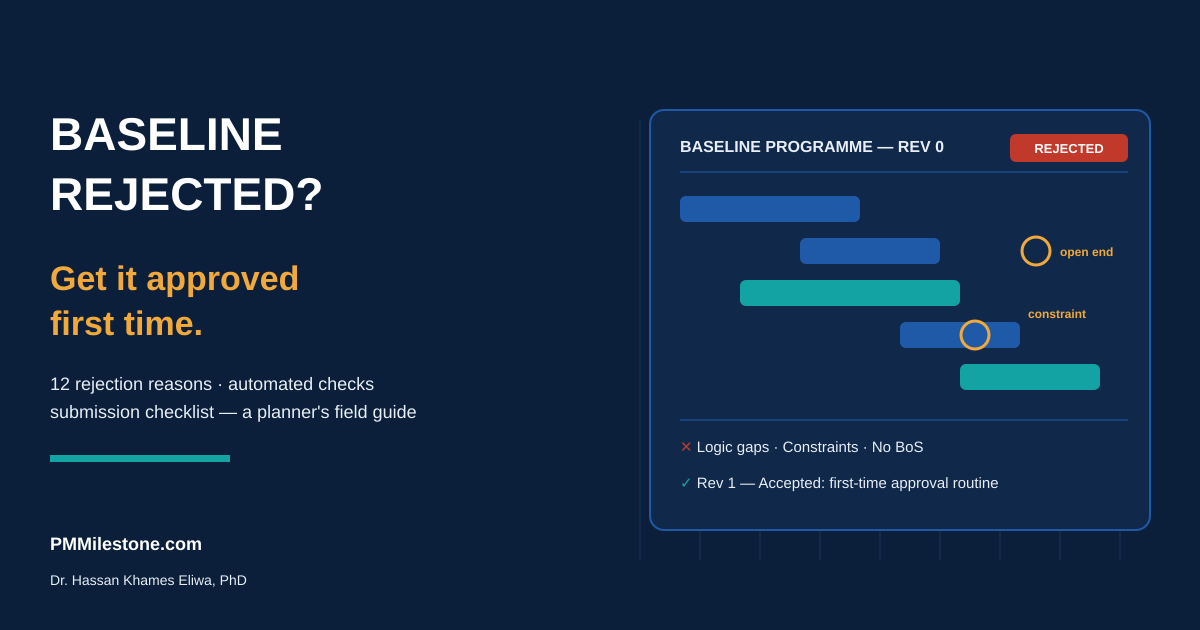
1. ❌ Logic gaps and open ends
Every activity except the project start and finish needs at least one predecessor and one successor. An activity with no successor will happily slip without moving anything — which means your critical path is lying. This is the single most common automated failure.
2. ❌ Constraints doing the job that logic should do
"Start On or After" and "Finish On or Before" constraints are sometimes legitimate — access dates, utility shutdowns, permits. But when a reviewer sees 40 hard constraints on a 900-activity schedule, they read it as: the planner forced the dates because the logic didn't produce them. Mandatory constraints are worse; they can create negative float that hides genuine delay.
3. ❌ No basis of schedule (or a two-page one)
The schedule is the model; the basis of schedule (BoS) is the explanation. Without it, the reviewer has to guess your assumptions about shifts, productivity rates, crane strategy, sequencing and weather. When reviewers guess, they reject.
4. ❌ Durations nobody can trace
"Pour Level 12 slab — 6 days." Why six? From what quantity, what crew, what productivity? If a duration cannot be traced to quantities and rates (or to a supplier's quotation), a good reviewer will challenge it.
5. ❌ Resources or quantities not loaded when the contract requires them
Many contracts require resource-loaded or cost-loaded baselines. Submitting an unloaded programme against that requirement is an automatic rejection, regardless of logic quality.
6. ❌ Calendar errors
A seven-day calendar on finishing works. No public holidays. A curing activity on a five-day calendar so the concrete "stops curing" at weekends. Calendars are invisible on a Gantt chart and painfully visible in a forensic review later — reviewers know this.
7. ❌ A critical path that doesn't make sense
If the longest path runs through landscaping on a hospital project, something is wrong. Reviewers expect the critical path to run through the work everyone on site knows is driving: structure, envelope, MEP, testing and commissioning.
8. ❌ Excessive total float
Activities with hundreds of days of float usually signal missing logic. The DCMA guideline treats more than 44 working days of total float on more than 5% of incomplete activities as a warning sign, and many owners adopt similar thresholds.
9. ❌ Contract milestones and key dates misaligned
Sectional completion dates, access dates and key dates from the contract must appear exactly as written — same names, same dates, same definitions. A mismatch between your milestone and the contract's is a credibility problem, not a formatting one.
10. ❌ WBS that doesn't mirror the contract
If the bill of quantities is organised by building and zone but your WBS is organised by trade, the reviewer cannot reconcile progress against payment. Structure the WBS the way the client will want to measure.
11. ❌ Engineering, procurement and approvals left out
Construction-only baselines are a classic mistake. Shop drawing submissions, consultant review periods, long-lead procurement, authority approvals and mock-ups often drive the job for the first six months. Leave them out and your critical path is fiction.
12. ❌ Lags and leads used as hidden logic
A 25-day lag between "Formwork" and "Rebar" tells the reviewer nothing. Lags are not wrong in themselves, but large or unexplained lags hide work that should be modelled as activities. Negative lags (leads) are flagged by almost every automated tool.
How the automated first pass actually works
Before you submit, it helps to know what the "robot reviewer" is checking. Most tools are built around some version of the DCMA 14-point assessment, with owner-specific additions.
| Check | Typical threshold | What it tells the reviewer |
|---|---|---|
| 🔗 Missing logic | ≤ 5% of activities | Is the network complete? |
| ↩︎️ Leads (negative lags) | 0% | Is logic being manipulated? |
| ⏳ Lags | ≤ 5% of relationships | Is work hidden inside relationships? |
| 🔁 Relationship types | ≥ 90% Finish-to-Start | Is the network simple and traceable? |
| 📌 Hard constraints | ≤ 5% of activities | Are dates forced rather than calculated? |
| 📈 High float (> 44 days) | ≤ 5% of activities | Is logic missing somewhere? |
| 📉 Negative float | 0% | Is the plan already late on day one? |
| 📏 High duration (> 44 days) | ≤ 5% of activities | Is the detail sufficient to manage? |
| 💰 Resources | All activities loaded (if required) | Can progress and cost be measured? |
| 🧪 Critical path test | Delay propagates to finish | Is the critical path genuinely connected? |
The most important — and most ignored — check is the critical path test. Add 600 days to a critical activity in a copy of the schedule and reschedule. If the project finish does not move by 600 days, your critical path is broken somewhere, usually by a constraint or an open end. I run this on every baseline before it leaves my desk. It takes five minutes and has saved me from embarrassment more than once.
Real-world example 1: the tower that failed on day two
A few years ago I was supporting a contractor on a high-rise residential tower in the Gulf. The planner was capable, the logic was mostly sound, and the programme had around 2,800 activities. It was rejected in under 48 hours.
The reasons, from the engineer's quality-gate report:
- 312 activities with no successor — almost all of them finishing trades on upper floors, left open after a copy-paste of the typical floor fragnet.
- 37 "Finish On or Before" constraints placed on floor slabs to match the tender cycle time.
- A six-day calendar applied to all activities, including authority inspections that only happen five days a week.
None of these were difficult to fix. What hurt was the delay: the resubmission took three weeks because the team also had to answer the substantive comments that arrived in the meantime. Payment of the first interim certificate was held for the same period.
💡 Lesson learned: run your own automated check before you submit. If the owner can find it with a script in an hour, you can find it with the same script in ten minutes.
Real-world example 2: the hospital baseline that was "too clean"
The opposite case taught me just as much. On a hospital project, the contractor submitted a beautiful baseline: zero open ends, no constraints, every metric green. It was still rejected.
Why? The engineer's planner noticed that the medical equipment procurement and the authority's fire and life safety approvals were missing entirely. The schedule showed the building complete and handed over in month 26. In reality, medical gas certification and equipment installation would have taken it to month 31.
The metrics were perfect. The plan was not.
💡 Lesson learned: automated checks test the structure of a schedule, not its truth. A planner who only optimises for the tool is building a schedule for the software — exactly the trap I described at the start.
The submission routine that gets baselines approved
This is the routine I now follow — and teach — for every contractual baseline. It is not glamorous. It works.
- Step 1📄 Read the contract schedule clause
- Step 2🧱 Build WBS from contract & BoQ
- Step 3🔗 Model logic, then calendars, then resources
- Step 4🔍 Self-audit (DCMA + critical path test)
- Step 5📝 Write Basis of Schedule & Exceptions Register
- Step 6🤝 Pre-submission walkthrough with the reviewer
Step 1 — Read the schedule clause like a lawyer
Before opening P6, read every specification section about the programme: required software and version, level of detail, maximum activity duration, resource or cost loading, submission format (XER, PDF, narrative), and the review period. Make a one-page compliance matrix. I have seen baselines rejected simply because the contract asked for P6 XER and the contractor sent an MPP file.
Step 2 — Build the WBS from the contract, not from habit
Mirror the contract's sections, buildings, zones and payment structure. If sectional completion exists, each section needs its own WBS branch and completion milestone.
Step 3 — Logic first, calendars second, resources third
Get the network right before you worry about dates. Then apply the correct calendars (working days, shifts, holidays, weather allowances). Load resources or quantities last, and only once the logic is stable — otherwise you will redo them three times.
Step 4 — Audit yourself before anyone else does
Run a DCMA-style check, the critical path test, and a quick scan of float distribution. Then do the human check: print the critical and near-critical paths on one page and ask the site team, "Does this match how you would build it?" If the construction manager laughs, start again.
Step 5 — Write the basis of schedule properly
A solid BoS answers the reviewer's questions before they ask them. Mine always includes: scope and key dates; working calendars and shift patterns; methodology and sequence for each major element; productivity rates and their sources; procurement and approval assumptions; risks and allowances included; and an Exceptions Register listing every constraint, long lag and high-float activity with a one-line justification.
Step 6 — Walk the reviewer through it before formal submission
This is the step most contractors skip and the one that makes the biggest difference. Ask the engineer's planner for a one-hour screen-share before you submit. Walk through the critical path, the key assumptions and the exceptions. You will hear their concerns while you can still fix them — and the formal review becomes a confirmation rather than a cross-examination.
✅ Pre-submission checklist
Copy this into your own submission template.
- ✅ Contract compliance matrix completed and attached
- ✅ All contract milestones, key dates and sectional completions match the contract wording exactly
- ✅ Every activity (except start and finish) has a predecessor and a successor
- ✅ Hard constraints below 5% and each one justified in the Exceptions Register
- ✅ No negative lags; positive lags minimal and explained
- ✅ Critical path test passed (delay on a critical activity moves the project finish)
- ✅ Total float reviewed; high-float activities checked for missing logic
- ✅ Calendars verified, including holidays, shift patterns and weather allowances
- ✅ Engineering, submittals, procurement, approvals, testing and commissioning included
- ✅ Resources/cost loaded if the contract requires it
- ✅ Basis of schedule written, reviewed internally and signed off by the project manager
- ✅ Pre-submission walkthrough held with the reviewer
⚠️ Common mistakes (and what to do instead)
| ❌ Mistake | ✅ Do this instead |
|---|---|
| Copying the tender programme and adding detail | Rebuild from the awarded scope; tender assumptions often changed during negotiation |
| Using constraints to hit the contract completion date | Fix logic and durations; if the dates still don't work, raise it now, not in month 9 |
| Hiding risk allowances inside activity durations | Show time risk allowance as a visible, named activity or explain it in the BoS |
| Treating reviewer comments as attacks | Respond line by line, with a "Contractor Response" column and an agreed action |
| Resubmitting only the changed parts | Resubmit the full package with a revision log and comparison report |
| Leaving the site team out of the baseline | Hold at least one logic review workshop with the construction manager and key supervisors |
| Arguing with the metric instead of explaining it | Accept the metric, then justify the exception in writing |
💡 Expert tips from the reviewer's chair
- Write the narrative for a tired reader. Reviewers often have several baselines on their desk. A one-page executive summary with the critical path in plain language buys a lot of goodwill.
- Show your productivity sources. "Based on 4.5 m³/hr pump rate and two pours per week from Project X records" is far more persuasive than a bare duration.
- Name activities as actions with locations. "Install ductwork — L5 Zone B" beats "Ductwork". Good naming is also what makes AI-assisted review tools read your schedule correctly.
- Keep a comparison report for every revision. Tools like P6's Claim Digger or a simple export comparison show the reviewer exactly what changed. It speeds up Rev 1 dramatically.
- Agree the review metrics upfront. If the owner uses an automated tool, ask for their threshold settings at the kick-off meeting. Most will share them.
- Don't over-detail. A 9,000-activity baseline for a mid-size building is not a sign of quality. It is a sign that nobody will be able to update it properly.
What an accepted baseline really buys you
It is tempting to treat baseline approval as an administrative hurdle — something to get through so the payment certificate can be released. That is a mistake.
The accepted baseline is the yardstick for every extension of time claim, every delay analysis and every float discussion for the rest of the project. If you have read our guides on delay analysis in construction projects or who owns the float, you will know that a weak baseline undermines every later argument. A credible, accepted baseline is the foundation that makes a time-impact analysis defensible.
Put differently: the hours you invest in the baseline are the cheapest hours of project controls you will ever spend.
❓ Frequently asked questions
Why was my baseline schedule rejected even though it passed the DCMA checks?
Because DCMA-style checks test the structure of the network, not whether the plan is realistic or complete. Reviewers also check scope coverage, sequence, productivity, procurement and approvals, and alignment with the contract. A schedule can be structurally perfect and still miss half the real-world drivers.How many hard constraints are acceptable in a baseline schedule?
A common guideline is no more than 5% of incomplete activities, but the real test is justification. Every constraint should relate to a genuine external date — access, permits, shutdowns, contract milestones — and should be listed with its reason in the basis of schedule.What should a basis of schedule include?
At minimum: scope and contract key dates, calendars and shift patterns, construction methodology and sequence, productivity rates and sources, procurement and approval assumptions, risk allowances, and an exceptions register explaining any constraints, long lags or high-float activities.How long does an owner usually take to review a baseline?
It depends on the contract. Many contracts specify a review period of around 14 to 30 days. With automated screening, initial quality-gate comments may arrive much sooner, so it pays to self-check before submission.What happens if the baseline is never formally accepted?
It creates real commercial risk for both parties. Payment may be withheld if it is linked to an accepted programme, and later delay claims become harder to assess because there is no agreed reference. Check the contract — some forms have deemed-acceptance provisions if the reviewer doesn't respond in time — and seek contractual advice if acceptance is stalled.Should the baseline be resource-loaded?
Only if the contract requires it or if you intend to use resources for progress measurement and earned value. If it is required, an unloaded baseline will almost always be rejected.Can AI tools build or review a baseline schedule for me?
AI tools are very good at the review side — finding logic gaps, constraint misuse and float anomalies quickly. They are not a substitute for knowing how the project will be built. Use them as a first-pass auditor, then apply your own judgement and site knowledge.What is the critical path test and how do I run it?
Make a copy of the schedule, add a large duration (for example 600 days) to an activity on the critical path, and reschedule. The project finish should move by the same amount. If it doesn't, something — usually a constraint or an open end — is breaking the critical path.
About the author: Dr. Hassan Khames Eliwa, PhD, is a project controls specialist and the founder of PMMilestone.org and PMMilestone.com. He has prepared, reviewed and defended baseline programmes on building, infrastructure and EPC projects, from both the contractor's and the owner's side. Project examples in this article are anonymised and simplified to protect client confidentiality.
Editorial note: Thresholds quoted reflect the commonly used DCMA 14-point assessment guideline; always follow the specific requirements of your contract and the owner's schedule specification.
People also ask
Follow-up questions practitioners search for next — each one points to the calculator, template or reference entry that answers it.
Which books deepen this career path?
Field handbooks on project controls, P6 scheduling and EVM. Books & Publications ↗
Which academy track maps to this career step?
Structured progression from planner to programme controls director. Project Controls Academy ↗
Which calculator should I learn first?
PV / EV / AC / CV / SV / CPI / SPI in one workbook — the gateway tool. EVM Calculator ↗
Which schedule tool will an interviewer expect me to know?
Runs the DCMA 14-point assessment against P6 / MS Project exports. Schedule Health Checker ↗