Who Owns the Float? A Planner's Field Guide to Float Ownership in Construction Contracts
This guide takes a planner's view: what the contracts actually say, how float behaves once it starts getting consumed, and what you can do in the baseline and in every update so that the answer to "who owns the float?" is never a surprise.
By Dr. Hassan Eliwa, PhD — Founder of PMMilestone.org & PMMilestone.com · 2026-11-17
Who Owns the Float? A Planner's Field Guide to Float Ownership in Construction Contracts
By Dr. Hassan Eliwa, PhD — Founder of PMMilestone.org & PMMilestone.com · Updated 2026-11-17 · https://pmmilestone.com/career-guides/who-owns-the-float-construction-contracts
Why this question keeps landing on the planner's desk
Every planner eventually gets the same phone call. The client has issued a late design change, or an approval has sat in someone's inbox for three weeks, and the activity it affects still shows positive float. The contractor's project manager wants an extension of time. The client's representative says, "It's not on the critical path, so there's no delay." Then both of them turn to the scheduler and ask, in slightly different tones, "So who owns that float?"
It sounds like a legal question. In practice it is half legal and half technical, and the technical half is the one that decides most disputes. You can have perfect contract wording and still lose the argument if the schedule underneath it can't be trusted.
This guide takes a planner's view: what the contracts actually say, how float behaves once it starts getting consumed, and what you can do in the baseline and in every update so that the answer to "who owns the float?" is never a surprise.
ℹ️ A note before we start. This is practical guidance from a project controls perspective, not legal advice. On a live dispute, read your own contract with your contracts manager or a construction lawyer.
First, be precise about which float
Half the arguments I see come from people using the word "float" for three different things.
| Float type | What it means | Who it typically affects |
|---|---|---|
| 🔵 Total float | How long an activity can slip before it delays project completion | Everyone. This is the float being argued about in most EOT disputes |
| 🟢 Free float | How long an activity can slip before it delays its immediate successor | Sequencing between trades and subcontractors |
| 🟠 Terminal (project) float | The gap between the contractor's planned completion and the contractual completion date | The contractor's commercial buffer. The most contested float of all |
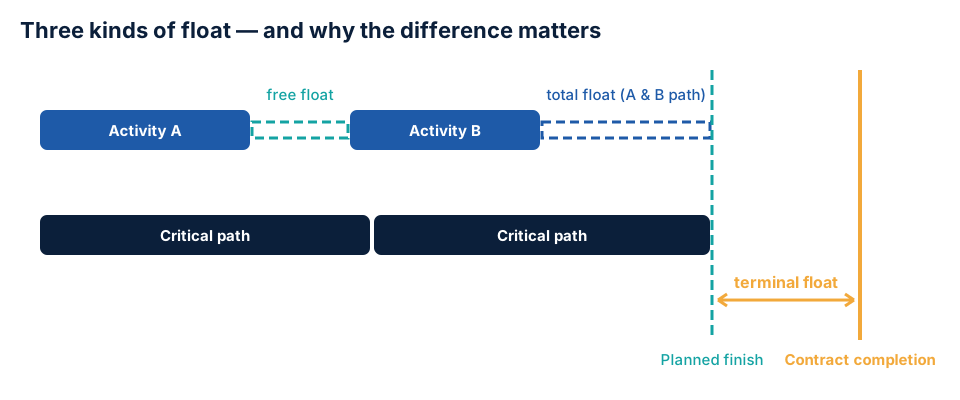
In Primavera P6, total float on the critical path is calculated against the project's must-finish date or its early finish. Which one you use changes the story. If you constrain the finish to the contract completion date, the terminal float shows up as positive total float on every critical activity. If you don't, it sits hidden in the gap between the project finish and the contract date. Same schedule, two very different pictures for anyone reading it.
💡 Expert tip: Agree in writing, at baseline acceptance, how terminal float will be shown. My preference is a visible "contract completion" milestone with the planned finish ahead of it, so everyone can see the buffer. A buffer that nobody can see is a buffer that gets argued about.
The three positions on float ownership
When the contract doesn't spell it out, you will hear three arguments. Each has a logic to it.
1. 🏗️ "The contractor owns the float"
The contractor built the programme, chose the sequence, and priced the risk. Any float they created through efficient planning is theirs, and if the employer's delay eats it, they've lost something of value. That loss can matter even when the completion date doesn't move, because their ability to absorb their own delays has gone.
2. 🏛️ "The employer owns the float"
The employer paid for the works and the programme. Float is a project resource, and the employer should be able to use it to make changes without paying for time that isn't really needed.
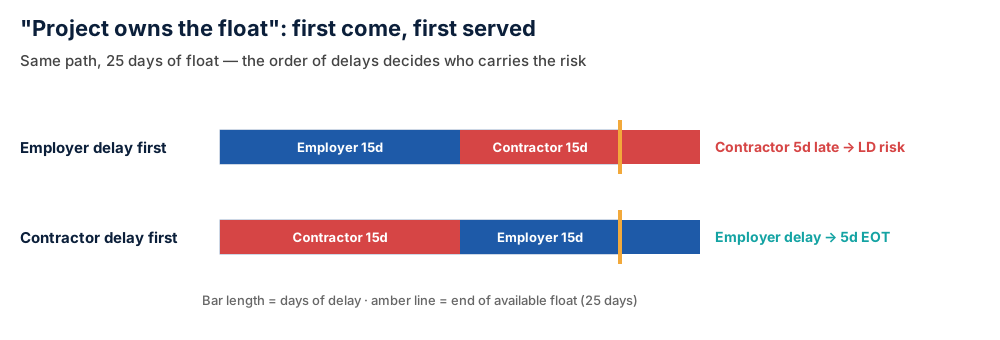
3. 🤝 "The project owns the float"
Neither party gets to hoard it. Float is shared, and in practice it's consumed first-come, first-served. Whoever's delay uses it first gets the benefit.
This third position is where most common-law markets have landed when the contract is silent. The SCL Delay and Disruption Protocol (2nd edition, 2017) treats float as not being reserved for the exclusive benefit of either party. AACE's Forensic Schedule Analysis recommended practice (29R-03) takes a similar shared-float view. In the UK, Ascon Contracting Ltd v Alfred McAlpine Construction Isle of Man Ltd (1999) is the case usually cited in support.
What the standard contracts actually say
This is the table I wish someone had given me fifteen years ago. It isn't a substitute for reading your particular amended version, because almost every major project amends these forms. It does show you where to look.
| Contract | Does it define float ownership? | How the EOT test is framed | Practical effect |
|---|---|---|---|
| NEC4 ECC | Not by name, but the mechanism is explicit | Clause 63.5: delay is measured against planned Completion on the Accepted Programme | ✅ Contractor's terminal float is protected. Employer delays that eat it still earn time |
| FIDIC (1999 / 2017) | ❌ No | EOT where completion "is or will be delayed" (Sub-Clause 8.4 in 1999, 8.5 in 2017) | ⚠️ Float generally has to be used up before an EOT is due. Effectively project float |
| JCT | ❌ No | Relevant Events that delay the Completion Date | ⚠️ Same as FIDIC. Float is usually consumed first |
| AIA A201-2017 | ❌ No | §8.3: extension "for such reasonable time as the Architect may determine" | ❓ Unsettled. Usually read as shared project float, but the loose wording invites argument |
| Bespoke / amended forms | ✔️ Often | Varies | 🔍 Read the float clause and the EOT clause together. They sometimes contradict each other |
Two patterns are worth noticing.
First, the EOT clause is the float clause, even when the word "float" never appears. If time is only granted when the contract completion date is delayed, float gets eaten first. If time is granted when the contractor's planned completion is delayed, the contractor keeps its buffer.
Second, amended forms are where the traps are. I have seen bespoke contracts state that "float belongs to the project" in one clause and require the contractor to show a minimum percentage of positive total float at baseline in another. Some US public-sector forms require 10% total float at baseline acceptance. Read together, those clauses tell you exactly who is expected to absorb the early delays.
How float actually gets consumed: four field scenarios
Theory is easy. Here is how it plays out on real jobs. The first scenario is one I've dealt with personally. The others are composites of situations planners run into all the time.
🔧 Scenario 1: The late approval that "wasn't critical"
On an infrastructure package, a client approval for a materials submittal came back about three weeks late. The affected activity carried roughly 25 working days of total float, so the client's position was simple: no impact, no time.
What the client's view missed was that this float wasn't idle. The same path carried a long-lead procurement item whose supplier had already warned of slippage. Once the client's late approval had consumed most of the float, the supplier's delay, which would have been absorbed, pushed the path critical. The contractor then faced liquidated damages for a delay that only became critical because the employer had used the float first.
Lesson learned: In a first-come, first-served regime, the order of events matters as much as their size. Record the date every delay event starts consuming float, not just when it ends. Without that, you can't reconstruct who used what.
🔧 Scenario 2: The NEC4 programme that protected the contractor
On an NEC4 job, the Accepted Programme showed planned Completion six weeks before the Completion Date. A compensation event pushed planned Completion out by four weeks, but the Completion Date was still two weeks away. Under clause 63.5 the contractor was entitled to four weeks, because the test is the movement in planned Completion, not whether the contract date was breached.
The client's commercial team initially rejected the quotation on the basis that "they'll still finish on time." It took a short, clear explanation of 63.5, and a programme that clearly showed both dates, to settle it.
Lesson learned: Under NEC, the Accepted Programme is the contractor's float protection. A programme that isn't accepted, or that hides planned Completion, throws that protection away.
🔧 Scenario 3: The float that was never real
A contractor claimed that client-caused delays had consumed 40 days of float on a fit-out sequence. When the schedule was reviewed, a third of the activities on that path had no successors at all. Their float was calculated to the project end date, not to anything that depended on them. The "40 days" was an artefact of open-ended logic.
Lesson learned: Before anyone argues about who owns the float, prove the float exists. Run a logic check first. Missing predecessors or successors, hard constraints and long lags all manufacture float that will collapse under forensic review.
🔧 Scenario 4: Float sequestering
A baseline arrived with every non-critical activity carrying preferential logic and inflated durations, leaving almost no visible float anywhere. On paper, every employer delay would immediately be critical and earn time. The reviewer rejected it, and rightly so. Hiding float to force every delay onto the critical path is a recognised tactic, usually called float sequestering or float suppression. Most competent reviewers will catch it.
Lesson learned: If you're the contractor, don't try it. It damages your credibility for the life of the job. If you're the reviewer, compare activity durations against norms and look for unexplained preferential links.
⚠️ Common mistakes that turn float into a dispute
- ❌ Arguing ownership before checking quality. If the schedule fails basic logic and constraint checks, the float figures are noise. Fix the schedule, then have the argument.
- ❌ Confusing "not critical" with "no impact." An employer delay that consumes float can still cause cost (disruption, re-sequencing, lost flexibility) even when it doesn't extend completion.
- ❌ Ignoring the data date. Float is a snapshot. A delay assessed against an update that's three months stale will give you a wrong answer, and an expert on the other side will say so.
- ❌ Letting the baseline go unaccepted. Without an accepted baseline, every float argument becomes your schedule against theirs.
- ❌ Mixing calendars without noticing. Float in P6 is calculated in the activity's own calendar. A 5-day path and a 7-day path will show different float for the same calendar gap. I've seen claims overstated by 30% because of this alone.
- ❌ No float log. If you can't show when float was consumed and by which event, you can't show who used it first.
- ❌ Treating the contract silence as a win. "The contract doesn't say, so it's ours" is not an argument. Silence usually means shared float.
🛠️ Expert tips: what the planner can actually control
You won't usually get to write the float clause. You do get to write the schedule, and that matters more than most people realise.
- 💡 Make terminal float visible. Show the contractual completion date as a separate milestone, with planned completion ahead of it. Name both clearly.
- 💡 Keep a float consumption register. For every delay event, record the activity, the float before and after, the start date of impact and the responsible party. A simple spreadsheet updated each period is enough. It becomes your best evidence.
- 💡 Report float trend, not just float. A path that drops from 30 days to 8 days over three updates is telling you something, even though it isn't critical yet. Near-critical trend reporting is where AI-assisted schedule tools are starting to earn their keep, flagging paths before they go critical.
- 💡 Use a near-critical threshold. Report everything under 10 working days of total float (or whatever suits the job) as near-critical. That gives both parties early warning before the ownership question becomes urgent.
- 💡 Agree the calculation settings up front. Retained logic or progress override, total float as finish float or start float, longest path or total float ≤ 0 for critical. Write it into the schedule narrative. Changing these mid-job silently moves float around.
- 💡 Run a schedule health check before every claim. A DCMA-style check on logic, constraints, lags and high float takes an hour and saves weeks of argument.
- 💡 Write the narrative as if a stranger will read it. One day, an expert witness will.
✍️ What a good float clause looks like
If you have any say in contract drafting, or you're advising the person who does, push for a clause that answers these questions explicitly:
- ☑️ Who may use float on non-critical activities, and in what order?
- ☑️ Is terminal float (planned vs contractual completion) reserved to the contractor?
- ☑️ How will float be shown in the baseline and in updates?
- ☑️ Is an employer delay that consumes float, but doesn't extend completion, compensable in cost?
- ☑️ How will concurrent delay be treated when float is involved?
- ☑️ Which delay analysis method will be used to assess float consumption (for example, time impact analysis or windows analysis)?
A clause that covers those six points will prevent more disputes than any amount of after-the-event analysis.
Lessons learned from the field
Over twenty years of planning, scheduling and delay work, a few things hold true on almost every project:
- 📍 The schedule decides the argument before the contract does. A credible programme with clean logic wins float disputes that a better-drafted contract with a poor schedule loses.
- 📍 Timing is evidence. "First-come, first-served" only works if you can prove who came first. Contemporaneous records beat retrospective analysis every time.
- 📍 Float has value even when it isn't critical. Losing it means losing the ability to absorb your own problems. That is a real commercial loss and should be treated as one.
- 📍 Transparency is cheaper than conflict. When both sides can see the float, they argue about facts. When it's hidden, they argue about motives.
Final thoughts
"Who owns the float?" is really three questions in one: what does the contract say, is the float real, and who used it first. Lawyers can answer the first. The planner owns the other two.
If you build a baseline with honest logic, show terminal float openly, log consumption every period and report trends before paths go critical, you'll rarely need to win the float argument, because you'll rarely have it.
📚 Related reading on PMMilestone: Delay Analysis in Construction Projects · EOT Claim Preparation Steps · How We Fixed −19 Days of Negative Float in Primavera P6 · Encyclopedia: Total Float
❓ Frequently Asked Questions
Who owns the float in a construction project if the contract says nothing?
In most common-law jurisdictions, the prevailing view is that the project owns the float. It's a shared resource, available to whichever party's delay uses it first. The SCL Delay and Disruption Protocol and AACE's recommended practice on forensic schedule analysis both take this shared position.Does the contractor own terminal float under NEC4?
In effect, yes. Under NEC4 ECC clause 63.5, delay from a compensation event is assessed against planned Completion on the Accepted Programme, not the contractual Completion Date. Terminal float therefore can't be used to absorb employer-risk events.Can a contractor claim an extension of time if the delayed activity still had float?
Under FIDIC, JCT and most forms that tie EOT to the contract completion date, generally not, unless the delay actually affects completion. Under NEC4, or where the contract measures delay against planned completion, an entitlement can arise even with time left before the contract date.Can a contractor recover costs when the employer consumes float but completion isn't delayed?
Sometimes. Depending on the contract, the contractor may still recover disruption or prolongation-related costs for the affected activities, even without extra time. This is one of the most frequently overlooked heads of claim.What is float sequestering?
It's the practice of hiding float in a schedule, through inflated durations, preferential logic or unnecessary constraints, so that every employer delay appears to be critical. Reviewers treat it as a red flag, and it can undermine a contractor's credibility.How should float be shown in Primavera P6?
Show the contract completion date as a separate finish milestone, with the contractor's planned finish ahead of it. State in the schedule narrative which scheduling options are used (retained logic or progress override, how critical is defined, total float calculation). Then keep those settings consistent across every update.Is negative float the same as delay?
Not exactly. Negative float means the current forecast can't meet a constraint or target date. It shows a projected shortfall, but whether that becomes compensable delay depends on cause, responsibility and the contract's EOT test.What's the best way to protect my position on float during a project?
Keep a period-by-period float consumption register, report near-critical paths and float trends, get the baseline formally accepted, and submit delay notices promptly with the schedule evidence attached.
This article is general professional guidance and does not constitute legal advice.
People also ask
Follow-up questions practitioners search for next — each one points to the calculator, template or reference entry that answers it.
Which calculator should I learn first?
PV / EV / AC / CV / SV / CPI / SPI in one workbook — the gateway tool. EVM Calculator ↗
Which schedule tool will an interviewer expect me to know?
Runs the DCMA 14-point assessment against P6 / MS Project exports. Schedule Health Checker ↗
Where do I look up the terms in this guide?
Single-line definitions for 1,200+ project-management and controls terms. PM Glossary on PMMilestone.org ↗
Which books deepen this career path?
Field handbooks on project controls, P6 scheduling and EVM. Books & Publications ↗