How to Pass the PMI-SP® Certification Exam
The ultimate scheduling guide — turning hard-won schedule experience into a credential that opens doors.
By Dr. Hassan Eliwa, PhD — Founder of PMMilestone.org & PMMilestone.com · 2026-06-22
How to Pass the PMI-SP® Certification Exam
By Dr. Hassan Eliwa, PhD — Founder of PMMilestone.org & PMMilestone.com · Updated 2026-06-22 · https://pmmilestone.com/career-guides/how-to-pass-the-pmi-sp-certification-exam
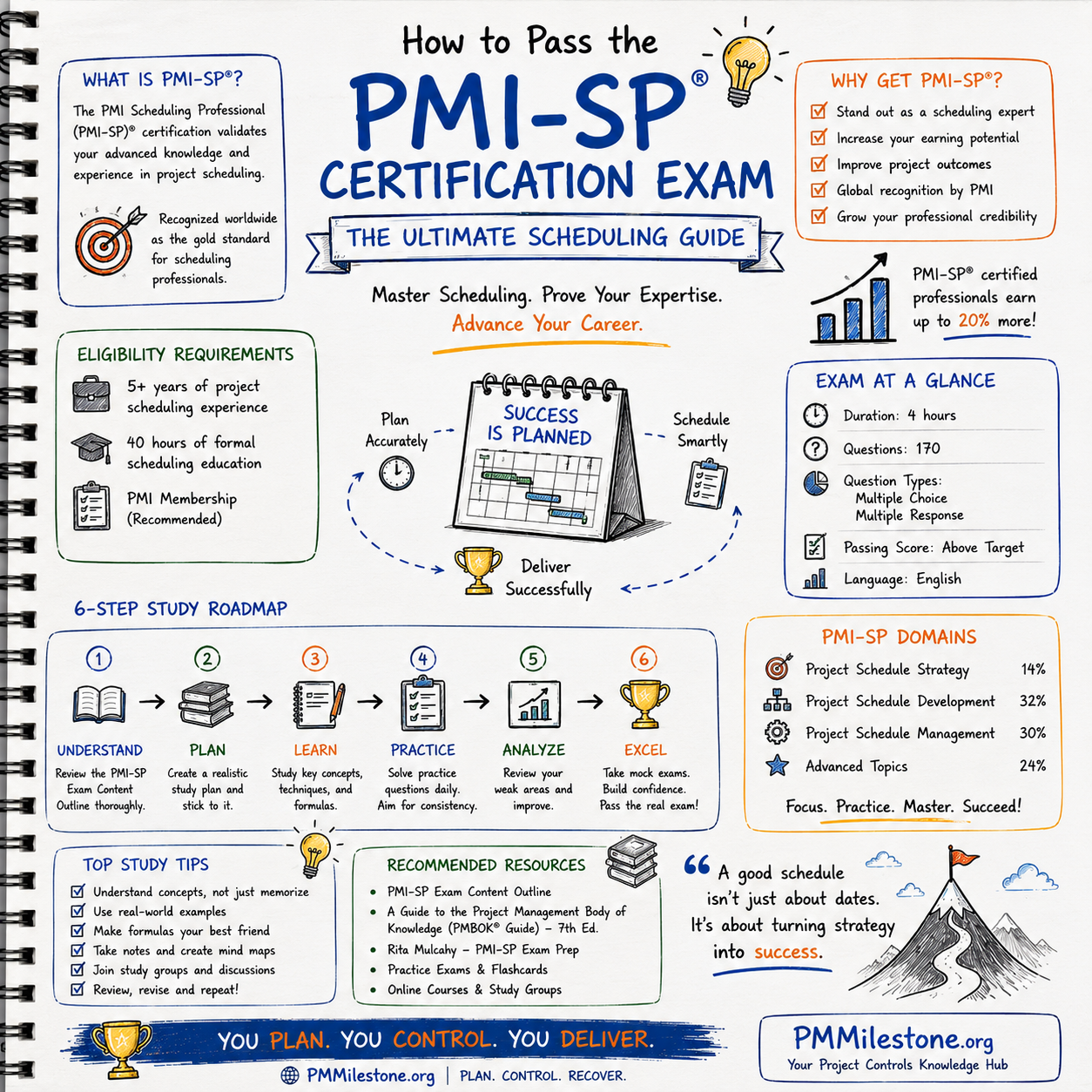
There is a moment in most schedulers' careers when the work outgrows the title. You've built and recovered schedules on serious programmes — a rail corridor, a tunnel drive, a treatment-plant upgrade — and yet on paper you're still "the planner." The PMI Scheduling Professional credential exists to close that gap. It is PMI's formal statement that the holder can develop, maintain, analyse, and communicate project schedules at a professional standard. This guide is about earning it efficiently, on the first attempt, without wasting weeks on the wrong material.
🏗️ Why a dedicated scheduling credential is worth the effort
On a megaproject, the schedule is not a document — it is the contract's heartbeat. Delay claims, extension-of-time arguments, cash-flow forecasts and resource decisions all trace back to it. A scheduler who can stand behind that artefact is one of the most valuable people on the team, and the PMI-SP is the cleanest way to signal that capability to clients and employers who don't already know your work.
| Reason | Why it matters on real programmes |
|---|---|
| Specialist credibility | Distinguishes a true scheduling expert from a generalist who dabbles in the programme |
| Career leverage | Supports the move from planner to senior controls or PMO scheduling lead |
| Earning potential | Specialist controls roles attract a premium, and the credential strengthens the case |
| Defensible schedules | Certifies the discipline behind EOT claims and delay analysis that hold up under scrutiny |
| Global currency | A PMI mark is recognised by clients and contractors across borders |
"Anyone can drag bars across a screen. The value is in the logic underneath, the honesty of the forecast, and whether the steering group believes the end date. That is what the PMI-SP actually certifies."
— Advice I give every junior planner
📋 Know the exam before you build your plan
Preparing without knowing the exam's shape is like baselining without a scope. Here is the current format, taken from PMI's Exam Content Outline rather than from simplified summaries.
| Element | Detail |
|---|---|
| Total questions | 170 multiple-choice |
| Scored vs pretest | 150 scored + 20 unscored pretest items (mixed in, unmarked) |
| Time limit | 210 minutes |
| Languages | English |
| Where | Pearson VUE test centre / online proctored where available |
| Retakes | Up to three attempts in a one-year eligibility window |
💡 Don't prepare against the wrong domain map. Some quick-reference graphics show four domains and a four-hour exam. PMI's current ECO defines five domains and a 210-minute limit. The five-domain map below is the one the questions are actually written from — build your study plan on it.
🧭 The five domains — a planner's tour
The exam spreads across five domains, but the weight is far from even. Schedule Monitoring & Controlling and Schedule Planning & Development together account for roughly two-thirds of the scored content. Strategy and Stakeholder Communications take a meaningful slice each, and Closeout is small but still examinable.
Figure 1 — The five PMI-SP domains and their relative weight
- Schedule Strategy (14%). Choosing the scheduling approach, methods, tools, and resource strategy that fit the programme — the decisions you make before a single activity is logged.
- Schedule Planning & Development (31%). Decomposing scope, defining and sequencing activities, estimating durations, building network logic via the forward pass, and setting the baseline. See Baseline Schedule, the WBS, the Integrated Master Schedule and rolling-wave planning.
- Schedule Monitoring & Controlling (35%). Updating progress, analysing variance and trends, forecasting with earned schedule and EAC, and driving corrective action — the heaviest domain.
- Schedule Closeout (6%). Final updates, lessons learned, archiving, and clean handover of the schedule.
- Stakeholder Communications Management (14%). Reporting, schedule narratives, and tailoring information so different audiences can act on it.
📈 Where forecasting earns its keep
The control domains are not about admiring a baseline — they are about telling the truth about where the programme will actually land. Earned value analysis — read alongside the CPI and earned schedule — is the backbone of that conversation. On a tunnel programme, a quiet drift in the earned-value curve flagged a slip months before it would have shown up as a missed milestone, which gave us time to re-sequence rather than just report bad news. The SPI Calculator and CPI Calculator are useful drill aids.
Figure 2 — Forecasting from the baseline: Planned Value, Earned Value and Actual Cost
| Curve | What it represents | The story when it diverges |
|---|---|---|
| Planned Value (PV) | The baselined value of work scheduled | Your reference line — never moves without change control |
| Earned Value (EV) | The baselined value of work actually completed | EV below PV means work is behind plan |
| Actual Cost (AC) | What that completed work has cost so far | AC above EV means it is costing more than the value delivered |
A scheduler who can read those three lines and say "we're behind and burning faster, here is the recovery option" in one sentence is worth their weight in float.
✅ Check your eligibility first
PMI provides three qualifying routes; you need to meet only one. Crucially, the experience must be in project scheduling specifically and earned within the last five years.
| Route | Education | Scheduling experience | Scheduling education |
|---|---|---|---|
| Set A | Secondary degree | 40 months in last 5 yrs | 40 contact hours |
| Set B | Bachelor's / four-year degree | 24 months in last 5 yrs | 30 contact hours |
| Set C | GAC-accredited degree programme | 12 months in last 5 yrs | 30 contact hours |
💡 Count your tool training toward the hours. PMI explicitly accepts formal training in Primavera P6, Microsoft Project, and other scheduling tools toward the required scheduling-education hours. Many candidates already hold most of what they need and don't realise it.
📅 An eight-week sprint plan
If you already live in the schedule, eight focused weeks is enough. The plan below front-loads a diagnostic, weights the learning toward the heavy control and development domains, runs critical-path and EVM drills in parallel throughout, and protects the final stretch for mocks and review.
Figure 3 — An eight-week PMI-SP sprint plan in Gantt form
| Phase | Wk 1 | Wk 2 | Wk 3 | Wk 4 | Wk 5 | Wk 6 | Wk 7 | Wk 8 |
|---|---|---|---|---|---|---|---|---|
| Diagnostic mock + ECO | ■ | |||||||
| Strategy & planning | ■ | ■ | ■ | |||||
| Development & network logic | ■ | ■ | ■ | |||||
| Monitoring, control & forecasting | ■ | ■ | ■ | |||||
| Closeout & communications | ■ | ■ | ||||||
| Daily CPM + EVM drills | ■ | ■ | ■ | ■ | ■ | ■ | ■ | ■ |
| Full timed mocks | ■ | ■ |
⚖️ How the PMI-SP sits against other credentials
Schedulers often weigh the PMI-SP against the AACE PSP and the PMP. They serve different purposes, and the right one depends on where you want your career to point.
| PMI-SP® | PSP (AACE) | PMP® | |
|---|---|---|---|
| Centre of gravity | Project scheduling | Planning & scheduling (cost-aware) | Whole-of-project management |
| Ideal candidate | Schedulers, controls leads | Planning specialists | Project / programme managers |
| Issuing body | PMI | AACE International | PMI |
| Schedule depth | High | High | Moderate |
| Signal to market | "I own the schedule" | "I plan and control" | "I lead the project" |
⚠️ The mistakes that catch good schedulers out
Treating it like a PMP-lite. The PMI-SP is narrower and deeper than the PMP. Generic project-management revision won't reach the depth of network logic, float analysis and forecasting that the scheduling exam expects.
Relying on tool fluency. Knowing P6 inside out is not the same as understanding the theory it implements. The exam tests concepts — critical path method, leads and lags, resource levelling, variance analysis — independent of any tool.
Skimming the lighter domains. Strategy and Stakeholder Communications are 14% each — more than a quarter of the exam combined. Candidates who pour everything into the control domains and ignore these leave easy marks on the table.
Skipping full-length, timed mocks. 170 questions in 210 minutes rewards pace and stamina. Untimed practice builds neither. Sit at least three complete, timed mocks before exam day.
📓 A lesson the schedule taught me
On a major water programme, I once inherited a baseline that looked immaculate — fully resourced, neatly logic-linked, beautiful to present. Within two months it had quietly become fiction, because no one had built a disciplined update and forecasting rhythm around it. The plan was a snapshot, not a control tool. We rebuilt the cadence: weekly progress capture, monthly variance and trend analysis, and a short forecast narrative every period. The baseline didn't change much; the discipline of controlling it changed everything, and the programme started landing its milestones again.
That is the lesson the PMI-SP encodes. Roughly two-thirds of the exam lives in development and control precisely because a schedule's value comes from how it is built and maintained, not from how it looks on day one. Study the exam with that truth in mind and the heavy domains stop feeling like a burden — they feel like the job.
💡 Expert tips for the exam room
Dump your formulas first. Before the pressure builds, write your key formulas — forward/backward pass, total float, SPI, schedule variance — onto the scratch sheet. Calculation questions then become mechanical rather than stressful.
Tag the domain, then answer. Silently label each question by domain as you read it. It keeps you applying the right lens — a control question and a planning question reward different reasoning.
Manage the clock like a milestone. At 170 questions in 210 minutes you have roughly 74 seconds each. Set internal checkpoints — about 60 questions per hour — and flag anything that stalls you rather than letting it bleed your time.
🧪 Concepts you should be able to explain in one sentence
A useful self-test before booking: if you can explain each of these to a non-scheduler in a single clear sentence, you understand it well enough for the exam. If you stumble, that's your study list.
| Concept | The one-sentence test |
|---|---|
| Critical path | Can you say why it determines the project's shortest possible duration? |
| Total vs free float | Can you distinguish slack against the project end from slack against the next activity? |
| Leads and lags | Can you explain when each is appropriate and how each shifts the logic? |
| Schedule baseline | Can you say what it is, why it's frozen, and how change controls it? |
| Earned value (SPI/SV) | Can you read the curves and state whether the work is ahead or behind, and by how much? |
| Resource levelling | Can you explain how it can extend the schedule and why that trade-off is sometimes right? |
On results: PMI does not publish a fixed pass mark; performance is reported against the domains using a scaled model. In your mocks, aim to sit comfortably above the 70% range across every domain rather than scraping an average — a single weak domain is what most often tips a borderline result the wrong way.
🎯 Key takeaways
Five things to carry into your prep.
Use the real blueprint. 170 questions, 210 minutes, five domains from the current ECO.
Follow the weight. Development and control are two-thirds of the exam — spend your hours there.
Theory over tools. Concepts like critical path, float and EVM are what's tested.
Respect the 14% domains. Strategy and communications together are over a quarter of the paper.
Train under exam conditions. Timed, full-length mocks build the pace and stamina you'll need.
The PMI-SP is the credential that finally matches the title to the work for serious schedulers. Prepare against the correct outline, lean into the domains that carry the most marks, and treat your own study like a programme you intend to deliver on time. Do that, and a first-attempt pass is well within reach. You plan. You control. You deliver.
🔗 Continue your scheduling career path
- Companion guide: How to Pass the PMP® Exam on Your First Attempt.
- Career roadmap: The Construction Scheduler Career Roadmap.
- Step into senior planning: How to Become a Senior Planner.
- Practice on the Schedule Health Checker, the SPI Calculator, and the EAC Calculator.
- Sharpen the controls toolkit: Change Order Management, Delay Analysis and the Look-Ahead Schedule.
Frequently Asked Questions
Is the PMI-SP harder than the PMP?
It isn't harder so much as deeper in one area. The PMP is broad across all of project management; the PMI-SP drills into scheduling theory and control. If scheduling is your daily work, you may find the PMI-SP more intuitive despite its specialist depth.How long should I budget to prepare?
Experienced schedulers often need six to ten weeks of consistent study. Allow more time if your hands-on exposure to formal critical-path method, baselining and earned value is limited.Do my Primavera P6 or MS Project courses count toward eligibility?
Yes. PMI accepts formal training in P6, MS Project and other scheduling tools toward the required project-scheduling education hours. Gather your course certificates before you apply.What is the most heavily weighted part of the exam?
Schedule Monitoring & Controlling at around 35%, followed by Schedule Planning & Development at about 31%. Together they make up roughly two-thirds of the scored questions.Can I take the exam online?
The PMI-SP is delivered through Pearson VUE, at a test centre and via online proctoring where available. Check current options when you schedule, and complete any required system check in advance.How do I keep the credential after passing?
Maintain it by earning 30 professional development units (PDUs) in each three-year cycle — through learning, teaching, presenting, reading, volunteering, or creating content.PMI-SP or AACE PSP — which one?
Both are respected scheduling credentials. PMI-SP carries the broader PMI brand recognition with clients; AACE PSP is often preferred on EPC and heavy-civil programmes where cost-aware planning dominates. If you work across both worlds, holding one then adding the other later is a strong combination.Is a credential really necessary if my work speaks for itself?
Your work convinces the people who already see it. The credential convinces clients, recruiters and steering groups who don't. On large programmes, that gap is where opportunities are won or lost.
People also ask
Follow-up questions practitioners search for next — each one points to the calculator, template or reference entry that answers it.
Which schedule tool will an interviewer expect me to know?
Runs the DCMA 14-point assessment against P6 / MS Project exports. Schedule Health Checker ↗
Where do I look up the terms in this guide?
Single-line definitions for 1,200+ project-management and controls terms. PM Glossary on PMMilestone.org ↗
Which books deepen this career path?
Field handbooks on project controls, P6 scheduling and EVM. Books & Publications ↗
Which academy track maps to this career step?
Structured progression from planner to programme controls director. Project Controls Academy ↗