How to Pass the PMP® Exam on Your First Attempt
The complete study guide — why smart, experienced people fail, and how to make sure you don't.
By Dr. Hassan Eliwa, PhD — Founder of PMMilestone.org & PMMilestone.com · 2026-06-20
How to Pass the PMP® Exam on Your First Attempt
By Dr. Hassan Eliwa, PhD — Founder of PMMilestone.org & PMMilestone.com · Updated 2026-06-20 · https://pmmilestone.com/career-guides/how-to-pass-the-pmp-exam-on-your-first-attempt
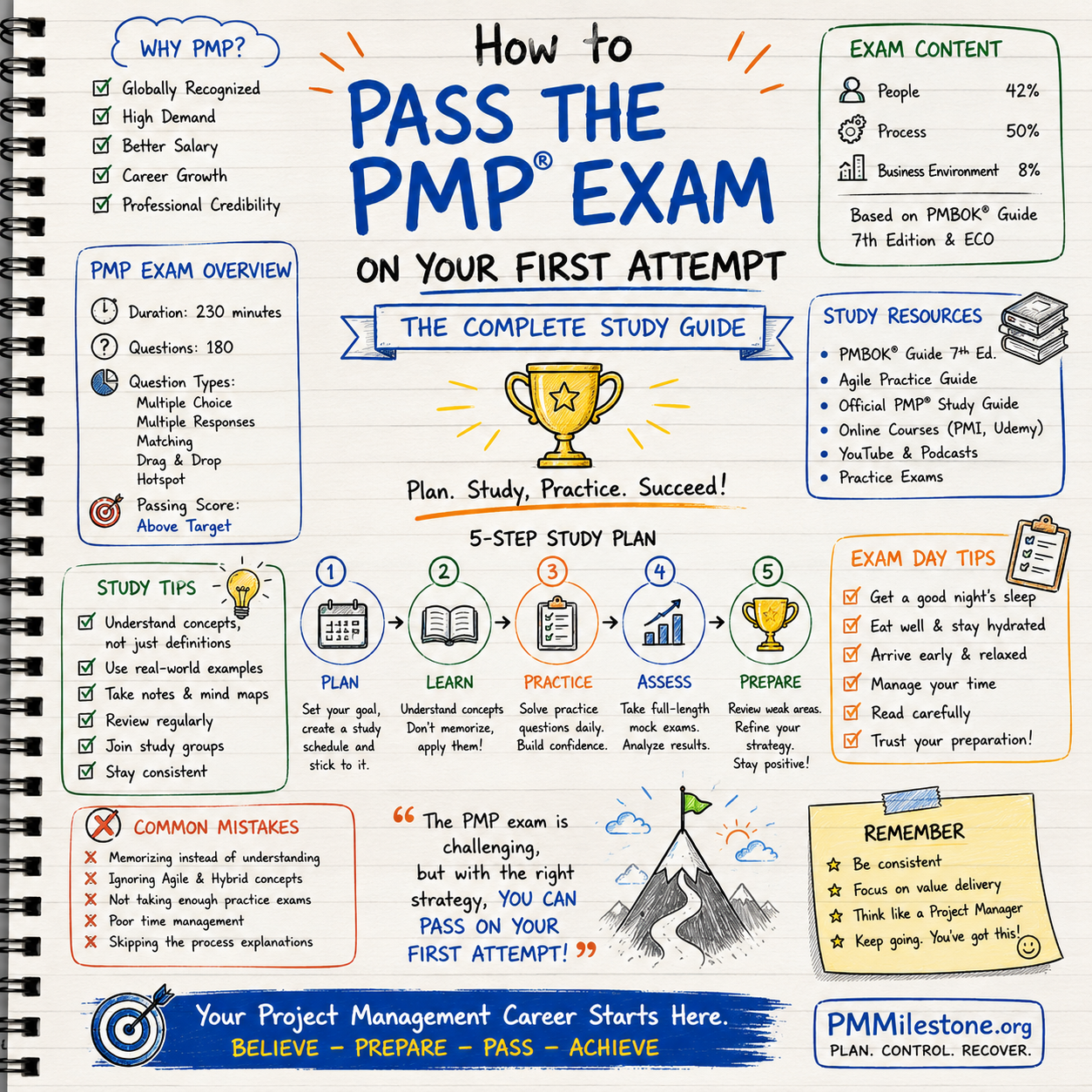
Here is an uncomfortable truth about the PMP exam: the people who fail it are rarely the ones who lack project experience. More often they are seasoned professionals who assumed competence on site would translate directly into a passing score. It doesn't. The exam isn't testing whether you can deliver a motorway interchange or a metro station fit-out. It is testing whether, given a messy scenario and four plausible answers, you will choose the one a textbook-perfect project manager would choose. That is a different skill, and it is learnable.
I've mentored a number of engineers and planners through this exam. The ones who pass first time aren't the most experienced — they are the ones who understood the assignment, rewired a few instincts, and practised relentlessly. This guide is built around that idea.
🎯 First, decide why you want it
Motivation sounds like a soft topic until week six, when your weekends are gone and the questions still feel hard. Candidates who pass have a concrete reason that survives that week. The honest business case for the PMP looks like this:
| Driver | What it actually buys you |
|---|---|
| Recognition | A globally portable signal that you manage projects to a recognised standard |
| Roles you can't reach without it | Many senior PM, PMO and programme roles now list it as required or strongly preferred |
| Earning power | PMI salary research shows a consistent premium for credential-holders over comparable peers |
| Credibility in the room | When you challenge a baseline or a risk position, the letters lend weight |
| A forcing function | Studying exposes the gaps between how you work and how the discipline says you should |
📋 Know the exam you're actually sitting
You cannot prepare efficiently for something whose shape you haven't studied. The current PMP is a 180-question paper sat over 230 minutes, and crucially it is weighted toward judgement rather than recall.
Figure 1 — How the current PMP exam is weighted across its three domains
Based on PMBOK® Guide Seventh Edition and the current Exam Content Outline.
The often-missed detail is the delivery-approach split. Roughly half the paper reflects predictive (waterfall) thinking and half reflects agile and hybrid. A predictive specialist who avoids agile — including the daily stand-up, retrospective and velocity mechanics — is gifting away a large share of the exam before they even begin.
Figure 2 — The predictive vs agile/hybrid balance woven through the exam
💡 A timing warning worth a calendar reminder. PMI launches an updated PMP exam on 9 July 2026, based on the PMBOK® Guide Eighth Edition and a new Exam Content Outline. The three-domain structure stays, but Business Environment expands considerably, the time rises to 240 minutes, and new case-study and graphic-based items appear alongside AI and sustainability topics. Sit on or before 8 July with current materials, or prepare for the new outline if your date falls later — either path earns the same credential.
🧠 The mindset shift nobody warns you about
This is the heart of first-attempt success. The PMP rewards a specific way of thinking, and for experienced practitioners it often runs against the grain of how their own organisation operates. Internalise the table below and a surprising number of "trick" questions stop being tricky.
| When a scenario asks… | Choose the answer that… |
|---|---|
| What should the project manager do first? | Understands and assesses before acting — not the dramatic fix |
| A conflict has arisen | Addresses root cause and collaborates, rather than escalating immediately |
| A stakeholder wants a change | Runs it through change control while protecting the relationship |
| Something has gone wrong | Is proactive and preventive, not reactive or blame-seeking |
| The team is struggling | Empowers and supports (servant leadership), not commands |
"On site I would have phoned the subcontractor and sorted it in ten minutes. On the PMP, the 'correct' answer was to gather information, review the agreement, and engage the team. Once I stopped answering as a site manager and started answering as PMI's ideal PM, my mock scores jumped."
— A motorway project PM I coached
📅 A realistic ten-week roadmap
Most working professionals need eight to twelve weeks. The schedule below is a ten-week version with a deliberate front-loaded diagnostic, parallel practice from the outset, and a final fortnight reserved for mocks and the error log. Treat your exam date as a fixed milestone and protect the critical path to it — exactly the way you would on a job, using the Critical Path Method you already know.
Figure 3 — A ten-week PMP study roadmap in Gantt form
| Phase | Wk 1 | Wk 2 | Wk 3 | Wk 4 | Wk 5 | Wk 6 | Wk 7 | Wk 8 | Wk 9 | Wk 10 |
|---|---|---|---|---|---|---|---|---|---|---|
| Diagnostic mock + ECO read | ■ | |||||||||
| People domain | ■ | ■ | ■ | |||||||
| Process — predictive | ■ | ■ | ■ | |||||||
| Process — agile / hybrid | ■ | ■ | ■ | |||||||
| Business Environment | ■ | ■ | ||||||||
| Daily scenario drills | ■ | ■ | ■ | ■ | ■ | ■ | ■ | ■ | ■ | ■ |
| Full timed mocks | ■ | ■ | ■ | |||||||
| Error-log review | ■ | ■ | ■ | ■ | ■ | ■ | ■ | ■ | ■ |
The non-negotiable feature is the daily drill bar — you are not allowed to "finish learning" before you start practising.
📚 Resources, ranked by usefulness
- Exam Content Outline (ECO). Free, official, and the actual blueprint. Read it first and return to it often.
- PMBOK® Guide and the Agile Practice Guide. Your conceptual foundation, not a script to memorise.
- A reputable question bank with explanations. Where most of your learning will happen — the explanations matter more than the questions.
- One structured course or study group. Accountability and a second perspective on the wording you'll face. The Project Controls Academy on PMMilestone.org runs cohorts that pair PMP prep with planning depth.
- Full-length, timed mocks. Non-optional. They build the stamina and pacing the real exam demands.
⚠️ Why experienced candidates fail — and how to not
Treating experience as a substitute for study. Your experience teaches you how your company runs projects. The exam tests how PMI says projects should run. Study the delta on purpose — it is where your instinct will quietly lead you to wrong answers.
Front-loading theory, starving practice. Reading for five weeks and practising for one is the classic failure curve. Application is the skill under test. Start answering questions in week one and let your mistakes set your reading agenda.
Avoiding agile because "we don't do that". Half the exam is adaptive or hybrid. Your workplace's methodology is irrelevant to PMI's blueprint. Give agile and hybrid first-class study time. Our Agile Project Management, Kanban, Story Points and Definition of Done entries are a useful primer.
Never simulating the full exam. Three and a half hours of sustained concentration is an endurance test. If your first full-length mock is on exam day, you have left a known, avoidable risk unmanaged.
📓 A lesson from a real near-miss
A structural engineer I worked with on a rail programme was, by any measure, an excellent project manager. He failed his first PMP attempt and was genuinely rattled. When we reviewed his preparation, the diagnosis took minutes: he had read three books, taken zero timed mocks, and answered every practice question untimed, looking up anything he was unsure of. He had effectively trained for an open-book, unlimited-time exam — which is not the exam PMI offers.
The rebuild was simple but strict. One full-length, timed mock each week. An error log reviewed before every session. A hard rule that agile questions got the same attention as predictive ones. He cleared the exam on his second attempt with room to spare, and told me afterwards that the timed mocks were the thing that changed everything — not because he learned new content, but because he finally learned to perform under the exact conditions of the test.
💡 Expert tips for the test itself
Find the question before you read the story. Jump to the final sentence first. Knowing what is being asked turns a long scenario from a wall of text into a search for specific evidence — faster and far less prone to misreading.
Eliminate two, then weigh the last two. Most questions have two clearly weaker options. Remove them, then ask which survivor is more proactive, collaborative, and value-focused. That tie-breaker is almost always the PMI answer.
Protect your energy budget. Take both breaks even if you feel fine. Accuracy in the final third of the paper is an energy problem disguised as a knowledge problem.
🌅 The 48 hours before the exam
- Stop learning new material. Review only your error log and high-yield summaries.
- Confirm logistics — ID, test-centre route or system check for online proctoring.
- Sleep properly two nights before, not just the night before.
- Eat something steady on the morning, and arrive or log in early and calm.
- Walk in expecting to flag and revisit questions — that is normal, not failure.
📊 Current exam vs the July 2026 update — at a glance
| Aspect | Current exam (until 8 Jul 2026) | Updated exam (from 9 Jul 2026) |
|---|---|---|
| Reference standard | PMBOK® Guide Seventh Edition + ECO | PMBOK® Guide Eighth Edition + new ECO |
| Domain weighting | People 42% / Process 50% / Business Env. 8% | Business Environment expands substantially; People and Process rebalance |
| Time | 230 minutes | 240 minutes |
| Emphasis | Predictive, agile and hybrid judgement | Adds AI, sustainability and value delivery |
| Question styles | MCQ, multi-response, matching, hotspot, fill-in | Above, plus new case-study and graphic-based items |
If your practice material is weighted to the wrong domain split, you are training for the wrong exam.
🛡️ Treat your error log like a risk register
Project controls people already know how to run a risk register — identify, categorise, prioritise, mitigate, review. Apply exactly that discipline to your wrong answers. For every question you miss, record the topic, the domain, why you got it wrong (knowledge gap, misread, or rushed), and the corrective action. Review the log before each session. Within a fortnight you'll see your top three failure modes as clearly as you'd see the top risks on a programme, and you can attack them directly instead of re-reading everything. The error log, not the textbook, is what converts hours into marks. If you want a worked example, see how earned value ties to CPI and EAC — those three concepts alone unlock a meaningful slice of the Process domain.
🎯 Key takeaways
The first-attempt formula in one box.
Understand the assignment. Answer as PMI's ideal PM, not as your workplace would.
Practise from day one. Mistakes are the curriculum; the error log is the syllabus.
Honour the 50/50 split. Agile and hybrid are half the paper — study them fully.
Simulate the conditions. Timed, full-length mocks build pacing and stamina.
Mind the calendar. Know whether you're sitting the current or the July 2026 exam.
Passing the PMP on the first try is far less about raw intelligence than about preparing for the right exam in the right way. Rewire a few instincts, practise under real conditions, and let your error log do the heavy lifting. Do that, and the result follows. Believe. Prepare. Pass. Achieve.
🔗 Continue your project controls journey
- Companion guide: How to Pass the PMI-SP® Certification Exam — the specialist scheduling credential.
- Career path: How to Become a Project Controls Engineer — A 5-Year Roadmap.
- Foundations: Earned Value Management, Work Breakdown Structure, Agile Project Management.
- Practice tools on PMMilestone.org Tools, the CPI Calculator, the EAC Calculator, and the PM Glossary.
- Stakeholder craft: Stakeholder Engagement and the RACI Matrix appear far more often in PMP scenarios than candidates expect.
Frequently Asked Questions
Can I pass the PMP without formal project management training?
You still need PMI's required project management education hours to be eligible to apply. Beyond eligibility, structured training paired with heavy practice is the most reliable route — self-study alone works but demands real discipline and an honest error log.How many hours a week should I study?
Ten to fifteen focused hours a week over eight to twelve weeks is a common, sustainable rhythm for working professionals. Consistency beats occasional marathon sessions every time, especially in the final fortnight.Is the PMBOK Guide enough on its own?
Rarely. It builds your conceptual base, but the exam tests application. Pair it with a strong question bank and full-length mocks, which is where most of the real learning happens.What is the biggest difference between the current and July 2026 exam?
The domain weightings rebalance — most notably Business Environment grows substantially — the exam aligns to PMBOK Eighth Edition, time increases to 240 minutes, and new question formats plus AI and sustainability content appear. The credential earned is identical.How do I handle the long, wordy scenario questions?
Read the actual question first, then mine the scenario for the few facts that matter. Watch for words like 'first', 'next', 'best' and 'except' — they change the answer entirely.If I fail, can I retake it?
Yes. PMI allows up to three attempts within your one-year eligibility period, with a retake fee each time. Use your score report's domain breakdown to target exactly where you fell short.Is the PMP worth it for someone already running large projects?
Usually yes — not because it teaches you how to deliver, but because it gives clients, employers and steering groups a recognised signal that your judgement maps to a global standard. Many senior PMO and programme roles now list it as required or strongly preferred.PMP or PMI-SP first?
If you lead whole projects, PMP first. If your craft is scheduling and you want to be recognised as a specialist, the PMI-SP is the cleaner signal — see our companion PMI-SP guide for the route.
People also ask
Follow-up questions practitioners search for next — each one points to the calculator, template or reference entry that answers it.
Which academy track maps to this career step?
Structured progression from planner to programme controls director. Project Controls Academy ↗
Which calculator should I learn first?
PV / EV / AC / CV / SV / CPI / SPI in one workbook — the gateway tool. EVM Calculator ↗
Which schedule tool will an interviewer expect me to know?
Runs the DCMA 14-point assessment against P6 / MS Project exports. Schedule Health Checker ↗
Where do I look up the terms in this guide?
Single-line definitions for 1,200+ project-management and controls terms. PM Glossary on PMMilestone.org ↗