EOT Claim Preparation Steps: Building an Extension of Time That Actually Gets Awarded
From first notice to final submission — record discipline, method selection between time impact and windows analysis, and how concurrency is handled under the SCL Protocol.
By Dr. Hassan Eliwa, PhD — Founder of PMMilestone.org & PMMilestone.com · 2026-07-27
EOT Claim Preparation Steps: Building an Extension of Time That Actually Gets Awarded
By Dr. Hassan Eliwa, PhD — Founder of PMMilestone.org & PMMilestone.com · Updated 2026-07-27 · https://pmmilestone.com/career-guides/eot-claim-preparation-steps-extension-of-time-that-gets-awarded
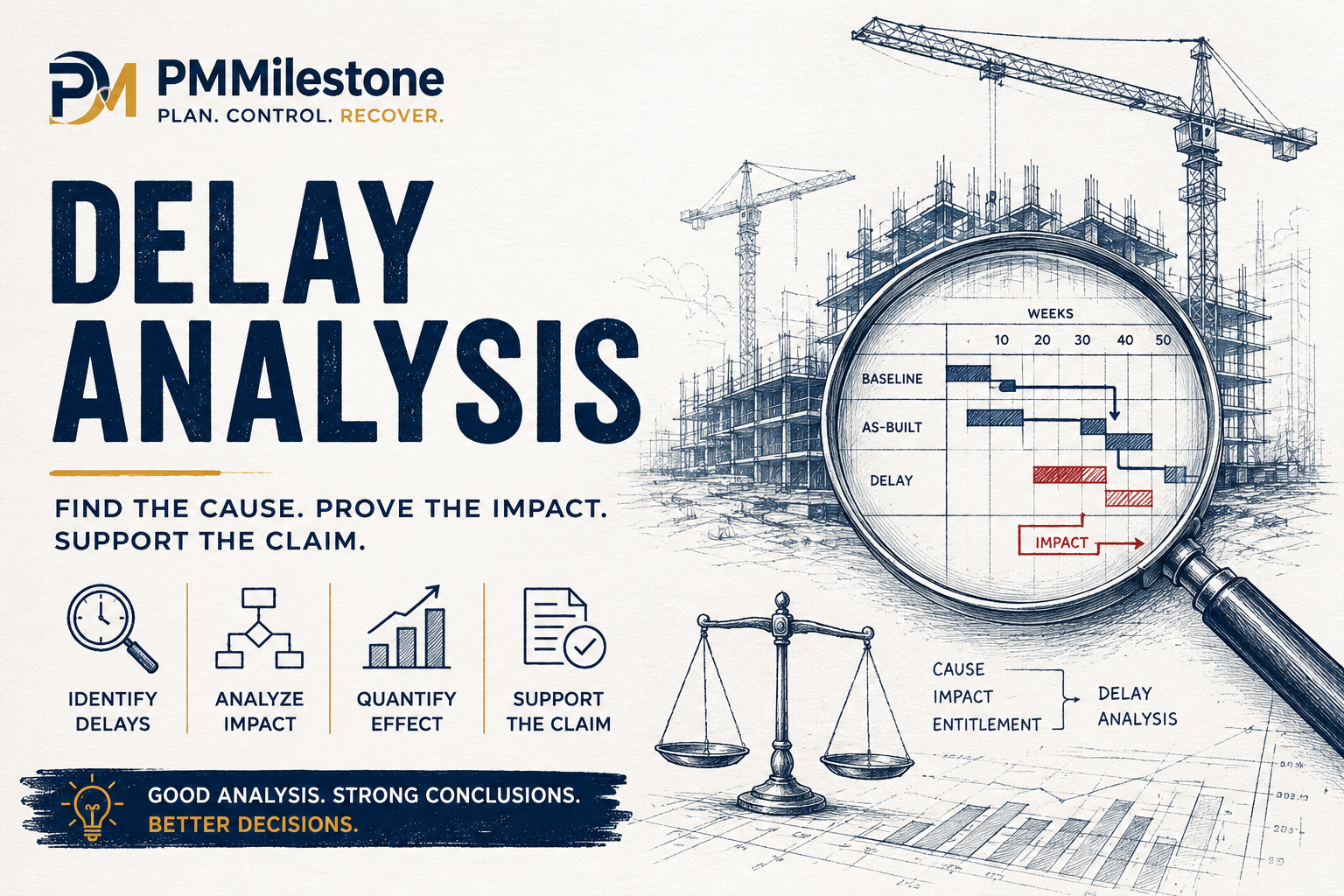
Ask any commercial manager why extension of time claims fail and you will hear the same answer: the analysis was wrong. In my experience that answer is almost never true. Most rejected claims contain perfectly competent analysis. They fail earlier, in places nobody photographs — a notice sent eleven days after a fourteen-day condition precedent, a baseline nobody ever formally accepted, a set of site diaries that stop in month seven because the engineer who kept them moved to another job.
An extension of time claim is an evidential chain, and a chain is only as strong as its weakest link. The forensic delay analysis sits somewhere in the middle of that chain. It matters, but it cannot repair what happens either side of it. This article works through the chain in the order it is built on a real project, using a station concourse and footbridge package as the running example, and deals with method selection and concurrency where they actually arise — as decisions inside a claim, not as academic topics.
The preparation sequence, in order
Every EOT submission I have seen succeed followed roughly the same seven stages. The order is not arbitrary. Stages one to three are gateways: get them wrong and nothing downstream can save the claim, regardless of how sophisticated the programme work becomes.
The seven-stage EOT claim preparation sequence
| 1 | 2 | 3 | 4 | 5 | 6 | 7 |
|---|---|---|---|---|---|---|
| Contract Trigger Check | Notice & Record Trail | Baseline Validation | Cause & Effect Establishment | Method Selection | Concurrency & Mitigation Test | Narrative & Submission |
| Clause, notice period, condition precedent | Written notice, diaries, photos, correspondence | Logic, calendars, float — is it fit to measure from? | Event → activity → path → completion date | TIA / windows / as-planned vs as-built | SCL logic, apportionment, acceleration check | Claim document, appendices, quantum linkage |
Figure 1 — The seven-stage EOT claim preparation sequence. Every assertion at every stage must be traceable to a dated, contemporaneous record — the evidence spine running underneath is not decoration.
Stage 1 — Confirm the contractual trigger before anything else
Open the contract and find three things: the clause that grants extension of time, the list of qualifying events, and the notice provision. Then answer the only question that matters at this point — is notice a condition precedent to entitlement? If it is, and you missed it, the honest position is that you may have no claim at all, and the conversation with your commercial lead needs to happen today rather than after three weeks of analysis.
| Contract family | Typical notice window | Condition precedent? | Practical implication |
|---|---|---|---|
| FIDIC Red Book (2017) | 28 days from awareness | Yes, expressly | Late notice is fatal to entitlement in most cases |
| NEC4 ECC | 8 weeks for contractor-notified events | Yes, for contractor CEs | Assessment is prospective — programme must be current |
| JCT Design & Build | 'Forthwith' on becoming apparent | Generally not | Delay in notifying weakens but rarely destroys the claim |
| Bespoke / amended forms | Frequently 7–14 days | Usually made express | Read the amendment, not the base form — this is where claims die |
Table 1 — Notice regimes by contract family. Orientation only; the governing wording is always the executed contract including amendments.
Stage 2 — Secure the record trail while it still exists
Records degrade fast. People leave, laptops get wiped, WhatsApp groups get archived, and the subcontractor who could explain the four-week gap in steel deliveries stops answering calls. Whatever the eventual method, the analysis is only as good as the contemporaneous material behind it, and the moment to collect it is the moment the event occurs.
| Record type | What it proves | Evidential weight | Frequency of failure |
|---|---|---|---|
| Programme updates with data dates | Movement of the forecast completion date | High | Low — usually exist, often unreliable |
| Site diaries / daily allocation sheets | Resources present, work fronts open, weather | High | Medium — stop mid-project surprisingly often |
| RFI and IFC drawing registers | Information availability and lateness | Very high | Low — but rarely date-stamped properly |
| Progress photographs (dated, located) | Physical status at a point in time | Very high | Medium — undated photos prove little |
| Minutes of progress meetings | What both parties understood at the time | Very high | Low — but often not signed off |
| Delivery dockets and GRNs | Material availability against programme need | Medium to high | High — commonly not retained |
| Correspondence and formal notices | Contractual compliance and awareness | Critical | Medium — informal channels used instead |
Table 2 — Record types ranked by evidential value. The right-hand column reflects where record-keeping most often breaks down on live projects.
On the station package described below, the entire footbridge argument turned on a single dated photograph showing the crane pad still under construction on the morning the possession opened. It proved the front was not available. No analysis in the submission carried a fraction of that weight.
Expert tip. One geotagged, dated photograph of every critical work front, taken at the same time each week, filed by activity ID. It costs a site engineer ten minutes and it has resolved more disputes than any software I have used.
Stage 3 — Validate the baseline before you measure anything from it
A delay analysis measures departure from a plan. If the plan cannot calculate a meaningful critical path, the measurement is meaningless. Before running any method, put the baseline through a health check and record the result — because the other side will run the same check, and it is far better to have disclosed a known weakness than to have it discovered.
| Check | Threshold applied | Why it matters for the claim |
|---|---|---|
| Formal acceptance status | Written acceptance on file | An unaccepted baseline is the most common ground of rejection |
| Open ends (missing predecessor/successor) | Under 5% of activities | Open ends break the longest-path calculation |
| Hard date constraints | None on or near completion | A constrained finish cannot move, so no delay can be demonstrated |
| Negative lag | Zero instances | Signals logic forced to fit a date rather than a method |
| Excessive activity durations | Under 5% exceeding 44 days | Long bars hide sequence and defeat window attribution |
| Calendars | Match actual working pattern and holidays | Wrong calendars distort every duration in the analysis |
| Total float distribution | Sensible spread, no mass zero float | Everything critical usually means the logic is over-constrained |
Table 3 — Baseline health check. Running this at award rather than at claim stage is the single highest-return habit in project controls.
The worked example: station concourse and footbridge
The package was a new concourse and pedestrian footbridge at an operational suburban station, with a contract duration of forty-eight weeks and a heavy dependency on engineering possessions for the bridge lift. It finished in week fifty-nine — eleven weeks late, with liquidated damages accruing weekly and a client relationship deteriorating in proportion.
Three employer-risk events were in play. A late instruction changed the footbridge parapet detail, which pushed steel fabrication out by four weeks and caused the contractor to miss its booked possession slot. A statutory undertaker diversion overran, restricting access to the north-east foundation zone. And an asbestos discovery in the existing ticket hall stopped fit-out for eleven days. Set against those were two contractor issues: a late order on the façade cladding package, and an under-strength services team during the fit-out phase.
Three-bar Gantt: baseline vs. EOT-adjusted vs. as-built
Figure 2 — Three-bar Gantt comparing the accepted baseline, the EOT-adjusted programme, and the as-built record. Red outlines mark the as-built critical path.
The three-bar presentation is worth adopting as a standard. A two-bar as-planned versus as-built chart shows the gap but implicitly invites the reader to attribute all of it to somebody. Adding the EOT-adjusted programme in the middle makes the argument visible at a glance: four weeks of the eleven belong to the employer, seven remain with the contractor, and the discussion moves immediately to whether that split is right rather than whether a split exists.
| Activity | Baseline | EOT-adj. | As-built | Variance to EOT programme | Driver |
|---|---|---|---|---|---|
| Enabling works | wk 0–4 | wk 0–4 | wk 0–5 | +1 wk | Utility diversion (Employer) |
| Piled foundations | wk 4–10 | wk 4–10 | wk 5–12 | +2 wk | Access restriction (Employer) |
| Steel fabrication | wk 6–18 | wk 6–22 | wk 7–24 | +2 wk | Parapet change (Employer) |
| Footbridge erection | wk 18–21 | wk 22–25 | wk 24–28 | +3 wk | Missed possession slot |
| Façade & roofing | wk 28–36 | wk 32–40 | wk 36–45 | +5 wk | Late cladding order (Contractor) |
| Fit-out & services | wk 34–44 | wk 38–48 | wk 43–54 | +6 wk | Asbestos + resourcing |
| Testing / handover | wk 44–48 | wk 48–52 | wk 54–59 | +7 wk | Cumulative knock-on |
Table 4 — As-planned vs. as-built. Measuring variance against the EOT-adjusted programme rather than the original baseline isolates residual contractor delay directly.
Once an EOT is awarded or provisionally assessed, rebuild the programme with the extension applied and measure subsequent performance against that. It separates delay the employer owns from delay the contractor owns without argument, and it makes the residual liquidated damages exposure explicit and manageable. Keep the original baseline intact and untouched in a locked file. Every re-baseline should be a new revision with a written justification, not an edit to the original.
Stage 5 in practice: choosing between Time Impact and Windows Analysis
With records secured and the baseline validated, the method question finally becomes answerable. The distinction is straightforward once stripped of jargon. Time impact analysis is prospective — you take the update immediately before an event, insert a fragnet modelling that event, recalculate, and read the movement of the completion date. Windows analysis is retrospective — you divide the project into periods, measure how far the forecast completion date moved in each period, and then establish from the records what drove that movement.
On the station package we ran windows analysis as the primary method, because monthly updates had been submitted and accepted throughout, and because five overlapping events across a forty-eight week programme would have produced a set of individual time impact analyses summing to well over the actual eleven-week overrun. We then ran two focused time impact analyses inside the contested windows — the parapet change and the asbestos discovery — because those two required a clear causal demonstration that the windows result alone did not provide.
| Selection factor | Points toward Time Impact Analysis | Points toward Windows Analysis |
|---|---|---|
| Programme update history | Sparse or unreliable updates | Regular accepted updates at monthly intervals |
| Claim timing | Live application during the works | Retrospective or final account position |
| Number of events | One to four discrete, separable events | Many overlapping events across a long duration |
| Contract mechanism | NEC compensation events; prospective assessment required | FIDIC and bespoke forms; retrospective assessment permitted |
| Critical path behaviour | Stable — one dominant chain throughout | Migrating — criticality shifts between packages |
| Concurrency present | Weak on its own; needs a separate concurrency test | Handles it naturally, competing causes visible in-window |
| Available budget and time | Limited — quicker to produce | Substantial — the most resource-hungry mainstream method |
Table 5 — Method selection matrix. In practice most disputed projects justify a hybrid: windows as the primary framework, TIA for causation on contested events.
It is worth being blunt about why this matters commercially. The same facts, run through different methods, produce materially different answers — and everyone in the room knows it. That is precisely why an unexplained method choice looks like manipulation and why a justified one carries weight.
Five methods, one set of facts — the range they produce
Figure 3 — Left: EOT produced by five methods on the same station package facts. Right: the trade-off between analytical effort and the weight the result is likely to carry in a dispute.
Impacted as-planned produced eleven weeks because it ignores as-built reality entirely and simply loads events onto the original network. Collapsed as-built produced four and a half because it removes employer events from the as-built and takes no account of what the contractor would have done differently. Windows analysis produced six — and six is where the matter settled, because it was the number the contemporaneous records could be shown to support line by line.
Stage 6: concurrency and mitigation under the SCL Protocol
The asbestos discovery and the services resourcing shortfall overlapped by nine working days on the station package, and both sat on the critical path during the fit-out phase. That is the classic setting for a concurrency argument, and it is where a great many claims are conceded too readily.
The Society of Construction Law Delay and Disruption Protocol sets a narrower test than site usage suggests. For delays to be treated as truly concurrent, there must be two or more effective causes running across the same period, each of them independently critical in its own right, with neither materially outweighing the other in causative potency. Two conditions in that description do most of the work. 'Independently critical' means each event, on its own, would have delayed completion — if one event only bites because the other has already consumed the float, they are sequential, not concurrent. 'Approximately equal causative potency' means that where one cause plainly dominates, the Protocol expects that to be stated rather than obscured behind a concurrency label.
| Question to test | If YES | If NO |
|---|---|---|
| Do the events overlap in time on the critical path? | Continue to the next test | Sequential delay — analyse in order of occurrence |
| Would each event independently have delayed completion? | Continue to the next test | Not concurrent — the non-critical event is irrelevant to EOT |
| Are the causes of roughly equal potency? | True concurrency established | Apply dominant cause — identify and attribute to it |
| Is the contractor already in culpable delay? | Check the contract; entitlement often restricted | Standard concurrency treatment applies |
| Was mitigation reasonably available and attempted? | Strengthens the claim materially | Expect a failure-to-mitigate argument in response |
Table 6 — A sequential concurrency test. Working through it in order prevents the most common error: labelling delays concurrent simply because they shared a calendar month.
Where true concurrency is established, the Protocol separates the two remedies. The contractor receives an extension of time, because the employer risk event did prevent completion by the contract date and the employer should not profit from its own delay by levying liquidated damages. The contractor does not recover prolongation cost for that period, because it would have been on site incurring those costs anyway because of its own delay. Time yes, money no. On the station package, that principle converted nine contested days into an EOT with no associated preliminaries recovery — a result both parties could live with, reached in one meeting.
Common mistakes on concurrency
- ⚠️ Conceding concurrency to appear reasonable. Contractors give away compensable weeks every year by accepting a label the facts do not support. Run the test in Table 6 before agreeing to anything.
- ⚠️ Assuming the SCL Protocol overrides the contract. It is guidance, not law. Where a bespoke clause addresses concurrency, float ownership or notice expressly, that clause governs.
- ⚠️ Claiming float as contractor property. Unless the contract says otherwise, float is a project resource. An employer event that consumes float without moving completion generates no EOT.
- ⚠️ Confusing acceleration with mitigation. Mitigation is the reasonable-endeavours obligation. Acceleration is additional cost and resource, and it needs an instruction — or a well-documented constructive acceleration case.
Stage 7: building the submission document
The final stage is where good analysis is most often wasted. An assessor is a person with a workload, a reputation to protect and limited time. The submission has to make approval the path of least resistance. That means a narrative a non-planner can follow, figures that carry the argument, and appendices that support rather than substitute for the story.
| Section | Purpose | Target length |
|---|---|---|
| Executive summary | Event, entitlement claimed, method, contractual basis — on one page | 1 page |
| Contractual basis | Clause references, notice compliance evidence, qualifying event status | 2–3 pages |
| Factual narrative | What happened, in chronological order, cross-referenced to records | 5–10 pages |
| Baseline and records | Validation results, update history, known limitations disclosed | 2–4 pages |
| Methodology | Method selected, why, and why alternatives were rejected | 2 pages |
| Analysis and findings | Window-by-window or event-by-event results with figures | 10–20 pages |
| Concurrency and mitigation | Test applied, conclusion reached, mitigation evidenced | 2–4 pages |
| Relief sought | Precise revised completion date, cost linkage if pursued | 1 page |
Table 7 — Submission structure. If the executive summary cannot be read and understood in five minutes, the document needs another draft, not another appendix.
📌 Practical habits. Disclose your own weaknesses first — an assessor who finds a gap you already flagged treats the rest as honest. Give a defensible number, not a maximum one. Index every record referenced with a document number, date and author. Use consistent activity IDs from baseline through analysis to appendices — renumbering between documents is a small thing that quietly destroys confidence.
Key takeaways
- 📌 Notice compliance and baseline validity decide more EOT claims than delay analysis ever does. Check both before doing any programme work.
- 📌 Collect records at the time of the event, not at the time of the claim. Reconstructed evidence is visible and it is discounted.
- 📌 Choose between time impact analysis and windows analysis on the strength of your update history, not on which produces the larger number.
- 📌 A hybrid approach — windows as the framework, TIA for contested causation — is usually the most defensible on complex projects.
- 📌 Measure ongoing performance against the EOT-adjusted programme so employer and contractor delay stay separable.
- 📌 Apply the full concurrency test before conceding anything; true concurrency is far rarer than the term's usage suggests.
- 📌 Under the SCL Protocol, established concurrency generally yields time without prolongation money.
- 📌 Write the submission for a busy assessor. Clarity converts a correct analysis into an awarded extension.
🔗 Related career guides
- 📘 How to become a delay analyst — the forensic career that grows directly from the notice, records and method discipline in this article.
- 📘 How we fixed -19 days of negative float in Primavera P6 — the P6 mechanics behind the baseline and update hygiene an EOT claim depends on.
- 📘 How expert planners read a Primavera P6 schedule in 10 minutes — the five-layer diagnostic that surfaces baseline problems before they become claim problems.
- 📘 Inside the Riverside office building Primavera P6 tutorial — an end-to-end P6 build that rehearses the baseline, updates and logic behind any credible EOT submission.
- 📘 Schedule entropy: why great schedules slowly become chaotic — the drift that quietly destroys the evidential value of a baseline.
Companion reading in the encyclopedia: Forensic Delay Analysis, Time Impact Analysis, Windows Analysis, Baseline Schedule, Float Management, Critical Path Method and Liquidated Damages.
The uncomfortable truth about extension of time claims is that most of the work that determines the outcome happens long before anyone opens a scheduling tool. Accepted baseline, honest updates, notices issued on time, records kept because somebody decided in month one that they would be. Build that foundation and the analysis becomes a straightforward technical exercise. Skip it, and no method — however expertly executed — will recover the position.
Frequently Asked Questions
What is the very first step in preparing an extension of time claim?
Read the contract and confirm the notice position. Identify the EOT clause, the qualifying events and the notice period, and establish whether notice is a condition precedent to entitlement. Everything else — records, programme validation, delay analysis — is wasted effort if a condition precedent has already been breached. On amended standard forms this check matters even more, because bespoke amendments frequently shorten notice periods and make them expressly conditional.How detailed does the delay analysis need to be for an EOT claim?
Proportionate to the value at stake and the sophistication of the assessor. A three-week claim on a small refurbishment does not need a five-window forensic analysis; a clear fragnet and a supporting record index will do. An eleven-week claim with liquidated damages at a serious weekly rate, likely to be reviewed by an external consultant, justifies a full windows analysis with disclosed methodology. The test is whether a reasonable assessor can follow the causal chain from event to completion date without having to construct it themselves.Can an EOT claim succeed without an accepted baseline programme?
It can, but it starts at a disadvantage and you should expect a discount. The usual approach is to build an as-built programme from contemporaneous records and run an as-planned versus as-built comparison or a collapsed as-built, stating the limitation openly rather than hoping it goes unnoticed. The stronger answer is preventative: obtain written acceptance of the baseline within the contractual period on every project, and treat re-baselining as a formal revision with recorded justification.Should time and cost be claimed together or separately?
Prepare them as linked but distinct components. Entitlement to time and entitlement to money arise from different tests, and concurrency is exactly the situation where they diverge — an established concurrent period typically produces an extension of time with no prolongation recovery. Presenting a single blended claim makes it easy for an assessor to reject both together. Present the time case, establish the periods, then attach cost to the periods that carry compensable entitlement.How is concurrent delay treated under the SCL Protocol?
The Protocol requires two or more effective causes of delay, of approximately equal causative potency, each independently critical, operating over the same period. Where that test is satisfied, the contractor is entitled to an extension of time but generally not to prolongation costs for the concurrent period, on the reasoning that those costs would have been incurred anyway because of its own delay. The Protocol is guidance rather than law, and an express contractual provision on concurrency will displace it.What if the employer simply does not respond to the EOT application?
Check the contract first — many forms provide for deemed acceptance or set a fixed period for assessment, and some make silence a breach in its own right. Keep applying formally and in writing, keep the programme updated to show accruing effect, and record the commercial consequence of the non-determination. Continued silence in the face of a properly notified and substantiated application is itself useful evidence, and it supports a constructive acceleration case if the contractor is forced to spend money to protect the completion date.How long should EOT claim preparation realistically take?
For a single discrete event with good records, a competent planner will produce a defensible submission in one to two weeks. A multi-event retrospective windows analysis on a two-year project is a two-to-four month exercise involving programme analysis, record review, narrative drafting and commercial input. The variable that dominates that range is not analytical complexity — it is the state of the records. Projects with disciplined record-keeping consistently prepare claims in a fraction of the time.
People also ask
Follow-up questions practitioners search for next — each one points to the calculator, template or reference entry that answers it.
Which calculator should I learn first?
PV / EV / AC / CV / SV / CPI / SPI in one workbook — the gateway tool. EVM Calculator ↗
Which schedule tool will an interviewer expect me to know?
Runs the DCMA 14-point assessment against P6 / MS Project exports. Schedule Health Checker ↗
Where do I look up the terms in this guide?
Single-line definitions for 1,200+ project-management and controls terms. PM Glossary on PMMilestone.org ↗
Which books deepen this career path?
Field handbooks on project controls, P6 scheduling and EVM. Books & Publications ↗