Inside the Riverside Office Building: How a Fictional Construction Project Teaches Real Primavera P6
A book feature on how one continuous 32-activity project — RVS-01 — turns Primavera P6 mechanics into professional scheduling judgement.
By Dr. Hassan Eliwa, PhD — Founder of PMMilestone.org & PMMilestone.com · 2026-07-12
Inside the Riverside Office Building: How a Fictional Construction Project Teaches Real Primavera P6
By Dr. Hassan Eliwa, PhD — Founder of PMMilestone.org & PMMilestone.com · Updated 2026-07-12 · https://pmmilestone.com/career-guides/inside-riverside-office-building-primavera-p6-tutorial
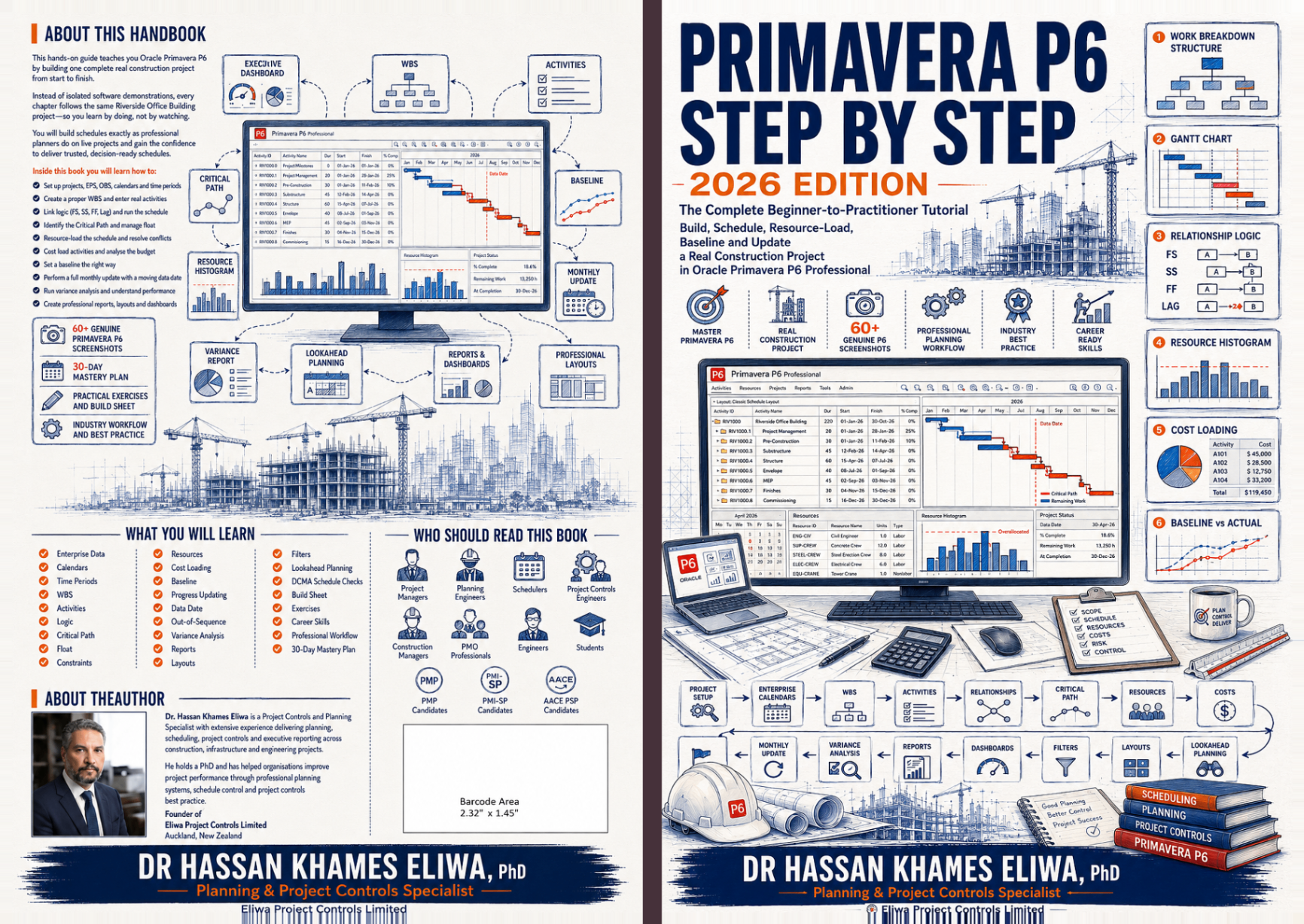
The best scheduling lesson I ever received did not come from a classroom. It came from a supplier who missed a delivery, a float column that quietly shrank, and a completion milestone that moved when nobody wanted it to. A new P6 tutorial book bottles exactly that experience — safely — and it changes how quickly beginners become useful.
There is a moment every scheduler remembers: the first time a delay they entered on one activity travelled through the logic and moved the end date of the whole project. Nothing teaches the reality of the critical path method faster — and nothing is harder to reproduce in conventional training, where examples are disposable and disconnected. Primavera P6 Step by Step — 2026 Edition by Dr. Hassan Khames Eliwa is designed around manufacturing precisely those moments, on demand, inside one continuously developed project.
🏗️ Meet RVS-01
The book's spine is the Riverside Office Building — project code RVS-01 — a compact two-storey commercial build with a planned start in October 2026. It is small enough to enter in an afternoon and honest enough to behave like a real job: four phases from preliminaries through fit-out, a three-level work breakdown structure, thirty-two activities including proper start and finish milestones, five priced crews, and a structural steel procurement chain deliberately routed in parallel with the substructure works. Readers do not read about this project. They build it, keystroke by keystroke, from an empty database to a statused programme reporting variance against an approved baseline.
That continuity is the pedagogy. Because the same project persists across all fourteen parts, the consequences of early decisions surface later exactly as they do in practice. The calendar you configure in Part 4 — including a four-day Christmas and New Year shutdown — visibly stretches the fit-out bars when you first press F9 in Part 9. The duration type you accept as a project default in Part 5 quietly determines how the resource assignments behave in Part 10. The tutorial never has to say "trust me, this matters" — it simply lets you meet the consequence.
| Attribute | Value |
|---|---|
| Project code | RVS-01 |
| Type | Two-storey commercial office |
| Planned start | October 2026 |
| Phases | Preliminaries · Structure · Envelope · Fit-out |
| WBS levels | 3 |
| Activities | 32 (incl. start & finish milestones) |
| Crews | 5 priced (ENG-CIV, SUP-CREW, STEEL-CREW, ELEC-CREW, EQU-CRANE) |
| Procurement | Structural steel routed in parallel with substructure |
| Non-work periods | 4-day Christmas / New Year shutdown |
🎬 Five scenes from the build
1. The wall of bars
After entering all thirty-two activities with durations but no logic, the reader confronts a sight every planner remembers: every bar piled against the data date, all starting the same morning. The book's framing is perfect — this is not an error but "a diagram of the information you have not provided yet." It is a small teaching choice, but it converts anxiety into understanding at the exact moment beginners usually feel lost.
2. Eighteen days of float, on the clock
Once the network is linked and scheduled, the steel procurement activity shows roughly eighteen days of total float — the substructure simply takes longer than the buying. The text is precise about what that number is: calculated permission to be late, shared along a path, owned by no one, and perishable. Then the progress-update chapter cashes the warning: the supplier slips, the reader enters an honest remaining duration, reschedules with a moved data date, and watches the float column shrink while the finish variance goes negative. Few books let you feel a forecast change under your own hands. (For the underlying arithmetic, see Total Float vs Free Float.)
3. Three crews of work, two crews on the books
The resource chapters build a five-crew dictionary with realistic hourly rates, assign every working activity, and then open the Resource Usage Profile on the site crew — which promptly spikes to 300% against a 200% availability ceiling during the envelope phase, when roofing, cladding, and windows stack up. The overload is left standing deliberately, briefed as a known staffing risk, and used to walk through the genuine decision sequence: re-sequence first, negotiate resources second, and leave automatic resource levelling alone until you can predict what it will do before pressing the button.
4. Minus ten days, on purpose
Rather than let readers meet negative float for the first time on a live contract, the book manufactures it safely: impose a Must Finish By date two weeks earlier than the calculated finish, press F9, and read the angry red numbers. Minus ten days means "this network misses the imposed date by ten working days" — a true statement about an impossible demand, not a software error. Then, crucially, the constraint is removed and the schedule re-run clean, with a memorable warning about how haunted schedules are made by constraints people forgot to delete.
5. The crew that would not wait
In the update chapter, one excavation activity is statused as starting a day earlier than its relationship allows — because that is what site crews do. The schedule log raises an out-of-sequence warning, and instead of treating it as a fault, the book treats it as a conversation: reality and logic disagree; which should govern the remaining work? The reader learns what Retained Logic preserves, what Progress Override risks, and why the professional response is to ask the site what actually happened and then improve the model.
🧭 The habits underneath the features
Threaded through the walkthrough is a set of professional disciplines the author clearly considers more valuable than any menu knowledge, and they ring true to anyone who has audited schedules for a living:
- 📌 Read the schedule log after every single F9 — it is the only place P6 volunteers what it could not reconcile.
- 📌 Two open ends per project — the first activity and the last — and zero constraints unless an external date genuinely exists.
- 📌 Never record progress before an approved baseline is created and assigned — the book is blunt about the difference, and about the
<Current Project>trap that makes variance report zero forever. - 📌 Collect remaining durations from the site, not percentages from hope — remaining duration drives the forecast; percent complete is its arithmetic shadow.
- 📌 Lag is a claim, not a cushion — and negative lag is banned outright, in agreement with every serious schedule-quality standard.
FIELD NOTE — Why one project beats fifty demos. The specific value of the RVS-01 approach is the connected chain. The calendar you build affects the dates you calculate; the baseline you set enables the variance you report; the slip you enter erodes the float you measured. That chain only exists when one project runs unbroken from empty database to monthly update — and that is exactly what fragmented YouTube tutorials cannot supply, because their examples reset every video.
🧪 Where the book fits in a scheduler's development
| Reader | What the book adds | Companion resource |
|---|---|---|
| Graduate engineer | End-to-end mental model before the first live schedule | 5-Year PCE Roadmap |
| Site engineer moving to planning | Software fluency built on top of field intuition | Site Engineer → Planner |
| Working planner | Habits audit — log discipline, constraint hygiene, baseline governance | Senior Planner Path |
| PMP / PMI-SP / AACE PSP candidate | Applied CPM mechanics that mirror the exam's practical questions | PMP Exam Strategy |
| Planning manager | A shared onboarding standard — identical project, identical checkpoints | PMO Manager Path |
📦 What you walk away with
Finish the book and you own more than knowledge. You have a complete, resource-loaded, baselined, statused P6 project you built yourself — portfolio evidence for interviews. You have the full build sheet to reconstruct it from scratch as practice, ten graded exercises that end with auditing a stranger's schedule, a fifty-term glossary in working language, a quick-reference card of every key and menu that matters, and a thirty-day plan that turns one read-through into durable professional skill. For project managers, planners, engineers stepping into project controls, and candidates preparing for PMP, PMI-SP, or AACE PSP, it is the rare software book that is really a book about professional judgement, with software as the medium.
🖨️ The last mile: making the schedule presentable
A strength that deserves separate mention is the reporting material, because it addresses the most common complaint managers make about planners: correct schedules that nobody else can read. The layouts chapter builds a purposeful working library — one arrangement for data entry, one for logic review, one for statusing, a rolling four-week look-ahead whose filter is written against the data date so it stays evergreen without maintenance, and an executive view showing only what senior audiences should see. The printing section then walks the page from a jumbled first preview to a titled, dated, one-page-tall landscape sheet with a proper header block — and is charmingly firm that an undated schedule print is "a rumour." Group-and-sort gets its own treatment too: the same thirty-two activities regrouped by resource become crew work-streams, and regrouped by ascending float become a risk register, which is the kind of ten-second manoeuvre that normally takes a spreadsheet afternoon.
🧰 From tutorial to template
Something subtle happens by the final chapters: the Riverside project stops being an exercise and starts being an asset. The appendix consolidates every scrap of its data — activities, durations, logic with lags, resource rates, assignments, and the full progress-update entries — into a build sheet you can reuse three ways. Rebuild it cold as deliberate practice (the book's first recommended exercise, with a target of doing it entirely from the sheet). Adapt it as the seed of your own project template, since its calendar structure, numbering scheme, and WBS pattern are deliberately conventional. Or use it as a controlled crash-test site: several of the ten graded exercises have you break the project on purpose — switch the scheduling option to Progress Override and watch the update behave differently, force negative float and repair it with logic, run the automatic leveller on a copy and study its choices. Controlled breakage in a disposable project is the fastest teacher in scheduling, and the book supplies both the site and the demolition plan.
🛒 Where to get it
Primavera P6 Step by Step — 2026 Edition is available on Amazon now — Kindle for instant access, and large-format 7×10 paperback and hardcover editions built so every screenshot is genuinely readable at your desk. See the full dedicated book page for edition-specific buy links, ISBN details and the FAQ.
- Buy Paperback: amazon.com/dp/1997355108
- Buy Hardcover: amazon.com/dp/1997355108
- Get PDF ($19.99): Instant PDF download
One project. Fourteen parts. Thirty-two activities. Five crews. And, by the end, a scheduler who has already felt every consequence the software is capable of delivering — safely, in a book, before ever meeting them on a job with real money attached.
🔗 Related career guides
If the Riverside walk-through fits how you learn, these companion guides on this site go deeper into the surrounding project-controls craft — the P6 diagnostic habits, the certifications that reward CPM fluency, and the career paths that pay for it.
- 📘 How expert planners read a Primavera P6 schedule in 10 minutes — the five-layer diagnostic method senior planners use to triage a stranger's P6 file, and the exact companion to the Riverside habits chapter.
- 📘 Schedule entropy: why great schedules slowly become chaotic — the discipline behind the Riverside "read the log after every F9" rule, applied to real programmes over time.
- 📘 How to become a Project Controls Engineer — 5-year roadmap — where P6 fluency sits inside the broader controls curriculum, year by year.
- 📘 How to become a Senior Planning Engineer on large construction projects — the promotion path for planners who can do everything the Riverside project teaches, and then some.
- 📘 How to pass the PMI-SP scheduling certification exam — the mechanics the Riverside book rehearses (CPM, float, constraints, EVM) mapped to the exam's domains.
- 📘 How to become a delay analyst — the forensic career that starts with the schedule-quality habits Riverside insists on from Chapter 1.
And the companion book page: Primavera P6 Step by Step — 2026 Edition — edition-specific buy links, ISBNs, FAQ and formats.
Frequently Asked Questions
Is the Riverside project data included, or do I invent my own numbers?
Everything is supplied: every activity ID, name, duration, relationship, lag, resource assignment, and progress entry, both in the chapters as you need them and consolidated in an appendix build sheet. You can rebuild the entire project later without opening a single chapter — which is, in fact, the book's first recommended exercise.Does it cover resource levelling?
It covers finding and diagnosing overloads thoroughly, presents the realistic resolution options, and explains what the automatic leveller does — while advising honestly that beginners fix overloads with sequence and negotiation first. One of the practice exercises has you run the leveller on a copy and study its choices.Will it help with P6 EPPM (the web version)?
Conceptually, almost entirely — same engine, same data model, same disciplines. The book is built on P6 Professional, the desktop client that remains the industry's serious schedule-development environment and the skill employers mean when they ask for P6.I am preparing for the AACE PSP. Is this relevant?
Directly. The PSP leans hard on CPM mechanics — passes, float behaviour, constraints — which are the book's Parts 8 and 9, and the practical component rewards exactly the kind of end-to-end build the Riverside project rehearses. PMP and PMI-SP candidates get similarly direct coverage of decomposition, dependencies, and schedule control.How is this different from free YouTube tutorials?
Fragmented videos teach clicks; a continuous project teaches consequences. The specific value here is the connected chain — the calendar you build affects the dates you calculate, the baseline you set enables the variance you report, the slip you enter erodes the float you measured — and that chain only exists when one project runs unbroken from empty database to monthly update.Does it explain the vocabulary, or assume it?
Both, sensibly: every term is introduced in context when the project first needs it, and a fifty-term glossary at the back restates each one in a working sentence or two — the kind of definitions you could actually say in a meeting. Terms like free float versus total float, retained logic, dissolve versus delete, and the three percent-complete types each get the plain-language treatment.Is there anything on delay claims?
The book is not a claims manual, but it deliberately builds the claims-ready habits: baselines created before progress and governed through change, an archive discipline of exporting the statused programme every period, notebook entries recording the basis of key durations, and honest out-of-sequence handling. The final chapter points readers toward time impact analysis as a next step — with everything here as the entry requirement.Can a team use it as a shared training standard?
That is arguably its best institutional use. Because every reader builds the identical project against the identical checkpoints, a planning manager can assign it as structured onboarding and then verify progress objectively — open the trainee's RVS-01, check the log, check the baseline assignment, check the update. Several teams will also find the layout library and the schedule-quality thresholds worth adopting directly as house standards.
People also ask
Follow-up questions practitioners search for next — each one points to the calculator, template or reference entry that answers it.
Where do I look up the terms in this guide?
Single-line definitions for 1,200+ project-management and controls terms. PM Glossary on PMMilestone.org ↗
Which books deepen this career path?
Field handbooks on project controls, P6 scheduling and EVM. Books & Publications ↗
Which academy track maps to this career step?
Structured progression from planner to programme controls director. Project Controls Academy ↗
Which calculator should I learn first?
PV / EV / AC / CV / SV / CPI / SPI in one workbook — the gateway tool. EVM Calculator ↗