How to Write a Schedule Narrative That Reviewers Actually Trust
A planner's field guide to the monthly schedule update narrative — what to include, how to explain critical path movement without sounding defensive, a ready-to-use structure, and how to work with (not against) the AI review tools owners now run on every update.
By Dr. Hassan Eliwa, PhD — Founder of PMMilestone.org & PMMilestone.com · 2026-11-27
How to Write a Schedule Narrative That Reviewers Actually Trust
By Dr. Hassan Eliwa, PhD — Founder of PMMilestone.org & PMMilestone.com · Updated 2026-11-27 · https://pmmilestone.com/career-guides/how-to-write-schedule-narrative-monthly-update
The update that nobody read — until the claim
A few years ago I was brought in to help a contractor prepare an extension of time claim on a mid-rise residential and retail project. The schedule files were in decent shape: monthly XERs, progress recorded, logic mostly intact. Then I opened the narratives.
Every month, for fourteen months, the narrative said almost the same thing: "Works are progressing in accordance with the programme. Minor delays experienced due to site conditions. The contractor is taking mitigation measures." Meanwhile the forecast completion date had slipped by 97 calendar days and the critical path had jumped from the structure to the façade and then to the MEP risers.
The owner's delay expert had a field day. Every time the contractor said "the late design information pushed us out in month six," the expert pointed at the month-six narrative, signed by the contractor, saying everything was fine. The XER showed the delay; the contractor's own words said there wasn't one.
That project taught me something I now repeat to every planner I mentor: the schedule file shows what moved. The narrative is the only place you get to say why — and it becomes evidence whether you write it well or not.
This guide is the routine I use to write monthly schedule narratives that reviewers accept, project managers actually read, and delay analysts can rely on years later.
Note on examples: the project stories in this guide are drawn from real assignments, with names, figures and identifying details changed or combined to protect clients.
What a schedule narrative actually is (and what it is not)
A schedule narrative is the written report that accompanies each schedule submission. It explains the status of the work, what changed since the last update, why it changed, and what the team intends to do about it.
The US Government Accountability Office's Schedule Assessment Guide treats the narrative as a core part of a reliable schedule, not an optional extra, and many public-sector specifications — US federal guide specifications for project schedules, state transportation departments and agencies such as Massachusetts DCAMM, which publishes narrative templates — make a narrative a condition of accepting the update. In the Middle East, UK and Australasia, you will find the same requirement buried in the contract's programme clause or the employer's requirements, often phrased as a "progress report" or "programme commentary."
What it is not:
- ❌ A copy of the monthly progress report with photos and safety statistics.
- ❌ A list of every activity that started or finished.
- ❌ A place to argue entitlement or threaten claims.
- ❌ A screenshot of the Gantt chart with "see attached."
A good narrative is closer to a short technical memo: precise, dated, numerical, and readable in ten minutes by someone who has never opened your XER.
Why narratives matter more in 2026 than they did five years ago
Two things have changed the game.
First, the first reader is often a machine. Owners and PMCs increasingly run every update through automated schedule-quality and forensic tools before a human looks at it. Tools in the Acumen, Nodes & Links, SmartPM and nPlan families — and now general AI assistants fed an XER and a prompt — will flag logic changes, duration edits, retained-logic issues and critical path shifts within minutes. The reviewer arrives at your narrative already holding a list of what changed. If your narrative does not mention a change the tool found, it looks like you hid it.
Second, AI makes it tempting to stop thinking. I now see narratives clearly drafted by an AI tool: fluent, confident and almost entirely generic. They describe the schedule in perfect English but never explain cause and effect, because the tool cannot know that the formwork subcontractor lost a crew to another site. Reviewers have learned to spot this, and it erodes trust fast.
The planners whose updates sail through in 2026 use automation for the data and keep the judgement for themselves.
- Critical path explanation92%
- Forecast completion vs previous update88%
- Logic and duration changes disclosed81%
- Key milestone status77%
- Delay events and causes70%
- Mitigation / recovery actions64%
- Upcoming 60-day look-ahead48%
The 8-section structure I use on every project
Over the years I have settled on a structure that works for building, infrastructure and EPC projects alike. It fits on four to eight pages for most projects, and the order matters: it answers the reviewer's questions in the sequence they ask them.
1. Executive summary (half a page, maximum)
Three to five sentences. Data date, forecast completion, movement since the last update, and the single biggest issue. If the project director reads only this paragraph, they should know whether to worry.
Example: "Data date 31 October 2026. Forecast Substantial Completion is 18 June 2027, a slippage of 9 working days from Update 11 (5 June 2027) and 23 working days behind the accepted baseline. The slippage is driven by late approval of the curtain wall shop drawings (RFI-214). The critical path has moved from the Level 6–8 slab cycle to the façade installation on the north elevation."
Notice what that paragraph does: dates, numbers, cause, and the path. No adjectives.
2. Data date, file references and scheduling options
List the file name, revision, data date, calendars and the scheduling options you used (retained logic or progress override, longest path or total-float definition of critical, open ends treatment). This sounds dull. It is also the section that saves you when an analyst tries to reproduce your dates two years later and gets a different answer.
3. Milestone status table
A simple table: milestone, baseline date, previous update forecast, current forecast, variance against both. Keep it to the contractual and key internal milestones — usually 6 to 15 lines.
| Milestone | Baseline | Update 11 | Update 12 | Var. vs prev. | Var. vs BL |
|---|---|---|---|---|---|
| Structure topped out | 14 Nov 2026 | 21 Nov 2026 | 21 Nov 2026 | 0 wd | -6 wd |
| Building watertight | 26 Jan 2027 | 09 Feb 2027 | 22 Feb 2027 | -9 wd | -19 wd |
| Substantial Completion | 20 May 2027 | 05 Jun 2027 | 18 Jun 2027 | -9 wd | -23 wd |
4. Critical path and near-critical path
This is the heart of the narrative, and the section most planners get wrong. Describe the path in words, from the data date to completion, in five to ten steps. Then state clearly whether it is the same path as last month, and if not, why it moved.
I also list the near-critical paths (typically total float under 10 or 20 working days). Reviewers love this because it shows you are watching what might become critical next month, not just what is critical today.
5. Changes since the last update
Every logic change, duration change, added or deleted activity, calendar change and constraint change goes here, with a one-line reason. I export the comparison from P6 (or a schedule comparison tool) and summarise it in a table. If there were 140 changes, I group them; I never pretend there were none.
6. Delays, causes and responsibility-neutral description
Describe each delay event factually: what happened, when, which activities it affected, and the effect on the forecast. Reference the correspondence (RFI, letter, instruction number). Do not argue entitlement here. Facts written calmly carry more weight in a later claim than adjectives written angrily today.
7. Mitigation and recovery actions
What is the team actually doing? Name the action, the owner, the date and the expected recovery. "Mitigation measures are being taken" is not a mitigation measure.
8. Look-ahead, risks and issues requiring decisions
A short view of the next 30–60 days: critical activities due to start, information or approvals needed from the owner, and risks that could move the path. End with any decisions you need from the client, with dates.
- Step 1Freeze & check the updateRun quality checks before you write a word
- Step 2Compare to last updateExport every logic, duration and date change
- Step 3Trace the critical pathLongest path, then near-critical paths
- Step 4Find the causesLink each movement to a dated record
- Step 5Draft the 8 sectionsFacts, numbers, then actions
- Step 6Peer review & issueA second planner reads it cold
How to explain critical path movement without sounding defensive
This is where experience shows. Junior planners tend to either hide movement ("no significant change") or over-explain it with pages of justification. Both make reviewers suspicious.
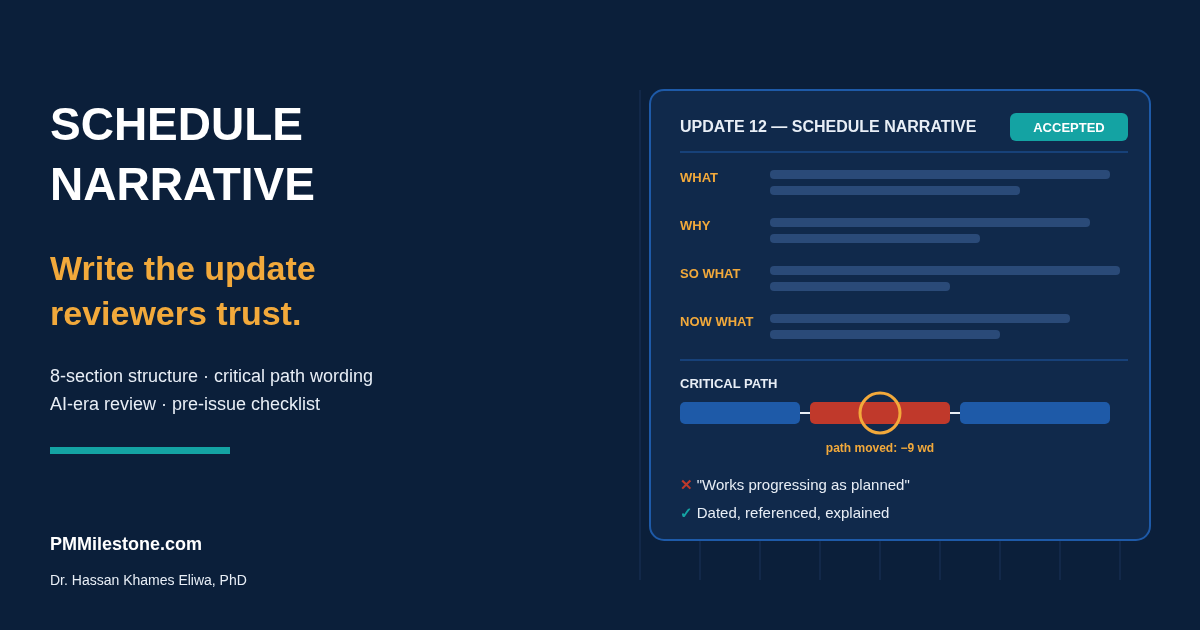
The pattern I teach is What → Why → So what → Now what:
- What moved: "Forecast completion moved 9 working days later, from 5 June to 18 June 2027."
- Why: "Curtain wall shop drawings (submittal CW-03) were returned 'Revise and Resubmit' on 14 October, 16 working days later than the review period allowed in the specification. Fabrication cannot start until approval."
- So what: "Façade installation on the north elevation is now on the longest path, followed by internal finishes on Levels 6–8, which depend on the building being watertight."
- Now what: "The façade subcontractor has agreed to a second installation crew from 1 December, which we forecast will recover 5 working days. We request approval of CW-03 Rev B by 15 November to hold the current forecast."
Four short paragraphs. Every claim is dated and traceable. There is no blame language, yet anyone reading it understands exactly whose action caused the movement.
Real-world example: the pump station that "didn't move"
On a wastewater pump station project, the forecast completion date held steady for four straight months. The narratives all said "no change to completion." The client was happy.
When I reviewed the files, the date was holding only because the planner had shortened three commissioning durations by a combined 18 days and removed a lag between mechanical completion and wet testing. None of that was mentioned in the narratives.
When the client's reviewer ran a comparison in month five, the trust was gone in one meeting. Every subsequent update was treated as suspect, and the team spent more time defending the schedule than managing the project.
💡 Lesson learned: A stable completion date that hides changes is worse than a slipping date that is explained honestly. Reviewers forgive slippage; they don't forgive surprises.
Real-world example: the narrative that won the extension
On a different project — a hospital fit-out — the planner had written brief, disciplined narratives every month using a structure very close to the one above. When a major design change to the medical gas system pushed completion out by seven weeks, the contractor's claim was assembled in days, not months. Each monthly narrative had already recorded the instruction number, the activities affected, the movement and the mitigation offered.
The owner's consultant accepted most of the time extension largely because the contemporaneous record was clear and consistent. Nobody had to reconstruct history.
💡 Lesson learned: Contemporaneous narratives are among the most persuasive documents in any delay discussion. Treat every monthly narrative as Exhibit A for a claim you hope never to make. (For the analysis side, see our delay analysis field guide and the guide to preparing an EOT claim that gets awarded.)
Using AI and automation the right way
I use automation heavily, and I recommend it. The trick is knowing which half of the job to hand over.
| ✅ Let the tools do this | 🧠 Keep this for yourself |
|---|---|
| Compare this update with the last one and list every change | Decide which changes matter and why they were made |
| Calculate the longest path and float paths | Explain in plain language why the path moved |
| Run DCMA-style quality checks and flag issues | Judge whether a flagged issue is a real problem |
| Produce the milestone variance table | Link delays to dated project records |
| Draft a first-pass summary of the data | Write mitigation actions with owners and dates |
| Check spelling, units and date formats | Sign the narrative and stand behind it |
A practical workflow I use: export the comparison report and float paths, give them to an AI assistant with a prompt that asks for a factual list of changes only, then write the causes and actions myself. I never paste AI text about causes into a narrative without verifying it against correspondence. An AI tool will happily invent a plausible reason — and a plausible but wrong reason in a signed narrative is a liability.
Common mistakes (and what to do instead)
| ❌ Common mistake | ✅ What to do instead |
|---|---|
| "Works progressing as planned" every month | State the forecast, the movement and the cause with dates |
| Hiding duration cuts or logic changes | Disclose every change with a one-line reason |
| Describing the critical path by activity IDs only | Describe it in words a project director can follow |
| Ignoring near-critical paths | List paths within your near-critical float threshold |
| Blame language and claim threats | Neutral facts with references to correspondence |
| "Mitigation measures are being taken" | Named action, owner, date and expected recovery |
| Pasting AI-generated causes unchecked | Use AI for data; write and verify causes yourself |
| Writing the narrative after the file is issued | Write it as part of the update, before submission |
| A 30-page narrative nobody reads | 4–8 focused pages; detail goes in appendices |
My pre-issue narrative checklist
Before any narrative leaves my desk, I run through this list. It takes fifteen minutes and has saved me from more resubmissions than I can count.
- ☑️ Data date, file name and revision match the submitted XER/XML exactly
- ☑️ Forecast completion and key milestones match the schedule file to the day
- ☑️ Variances are shown against both the previous update and the baseline
- ☑️ The critical path is described in words, start to finish
- ☑️ Any change in critical path is explained with a cause and a record reference
- ☑️ Every logic, duration, calendar and constraint change is disclosed
- ☑️ Delay events are factual, dated and referenced, with no entitlement argument
- ☑️ Mitigation actions have an owner, a date and an expected effect
- ☑️ Decisions needed from the client are listed with required dates
- ☑️ A second planner has read it without opening the schedule and understood it
If your baseline hasn't been accepted yet, fix that first — the monthly narrative only works when there is an agreed reference point. Our guide on why baseline schedules get rejected and how to get yours approved first time walks through that process.
Practical lessons from twenty-plus years of monthly updates
A few things I wish someone had told me when I wrote my first narrative:
- Write it the same week as the data date. Memory fades quickly. The reason a crew was short on the 12th is obvious on the 2nd of the next month and unknowable by the 20th.
- Keep a running delay log during the month. A simple spreadsheet with date, event, reference and affected area makes the narrative almost write itself.
- Talk to the site team before you write. Ten minutes with the construction manager will tell you more about why the path moved than an hour in P6.
- Be consistent month to month. Same structure, same headings, same table columns. Consistency is what makes a series of narratives useful as evidence.
- Watch your float behaviour. If negative float appears, say so and explain the recovery plan. Our negative float case study shows what that looks like in practice, and the float ownership guide explains why it matters contractually.
- Confirm your progress method. If you switch between retained logic and progress override, the critical path can change without any real-world event. State the option you used; our guide to out-of-sequence progress in P6 explains the difference.
❓ Frequently asked questions
What should a schedule narrative include?
At minimum: the data date and file reference, forecast completion and key milestone dates with variances, a description of the critical path and any change to it, all logic and duration changes since the last update, delay events with causes and references, mitigation actions, and a short look-ahead with decisions needed from the client. Always check your contract or specification, since many list mandatory contents.How long should a monthly schedule narrative be?
For most projects, four to eight pages of main text is enough, with detailed comparison reports and float listings in appendices. Very large programmes may need more, but length is not a sign of quality. If the project director cannot understand the status from the first half page, the narrative is too long or poorly structured.What is the difference between a baseline narrative and an update narrative?
A baseline narrative (often called a basis of schedule) explains how the plan was built: assumptions, calendars, sequencing logic, resources and exclusions. An update narrative explains what has happened since the last submission and how the forecast has changed. Both are needed, and the update narrative should refer back to the baseline assumptions when they turn out to be wrong.Should I mention delays caused by my own company in the narrative?
Yes, factually. Hiding contractor-caused delays damages credibility and can undermine later claims for employer-caused delays, because the record looks one-sided. Describe the event, its effect and your recovery plan. Neutral disclosure is very different from admitting liability, but if in doubt about contractual wording, ask your commercial or legal team before issue.Can I use AI to write my schedule narrative?
You can use AI to speed up the data side: comparing updates, listing changes, summarising milestone variances and checking language. You should not rely on it to explain causes, because it cannot know what happened on site and may invent plausible but wrong reasons. Treat AI output as a draft that you verify against project records before you sign.How do I describe a critical path change clearly?
Use the What → Why → So what → Now what pattern. State the movement in days and dates, give the cause with a reference to correspondence, describe the new path in plain words from the data date to completion, and explain the actions you are taking. Avoid listing only activity IDs, which most readers cannot follow.What if the forecast completion date has not changed?
Say so, but still confirm whether the critical path, near-critical paths or logic changed. A stable date can hide significant changes such as shortened durations or removed lags. Reviewers will check with comparison tools, so disclosing these changes yourself protects your credibility.Who should review the narrative before it is submitted?
Ideally, a second planner who reads it without opening the schedule, plus the project or construction manager to confirm the causes and mitigation actions are accurate. On contracts where the narrative carries contractual weight, a quick review by the commercial manager is also worthwhile.
Written by Dr. Hassan Khames Eliwa, PhD — planning and project controls practitioner and founder of PMMilestone. The views and examples in this guide are based on professional experience and are provided for education; always follow the requirements of your own contract and specification.
People also ask
Follow-up questions practitioners search for next — each one points to the calculator, template or reference entry that answers it.
Which schedule tool will an interviewer expect me to know?
Runs the DCMA 14-point assessment against P6 / MS Project exports. Schedule Health Checker ↗
Where do I look up the terms in this guide?
Single-line definitions for 1,200+ project-management and controls terms. PM Glossary on PMMilestone.org ↗
Which books deepen this career path?
Field handbooks on project controls, P6 scheduling and EVM. Books & Publications ↗
Which academy track maps to this career step?
Structured progression from planner to programme controls director. Project Controls Academy ↗