AACE Certifications: The Complete 2026 Guide to All Nine Credentials
All nine AACE International credentials, how the exams are actually built, what the application really asks of you, and how to work out which one belongs on your business card.
By Dr. Hassan Eliwa, PhD — Founder of PMMilestone.org & PMMilestone.com · 2026-09-04
AACE Certifications: The Complete 2026 Guide to All Nine Credentials
By Dr. Hassan Eliwa, PhD — Founder of PMMilestone.org & PMMilestone.com · Updated 2026-09-04 · https://pmmilestone.com/career-guides/aace-certifications-complete-2026-guide-nine-credentials
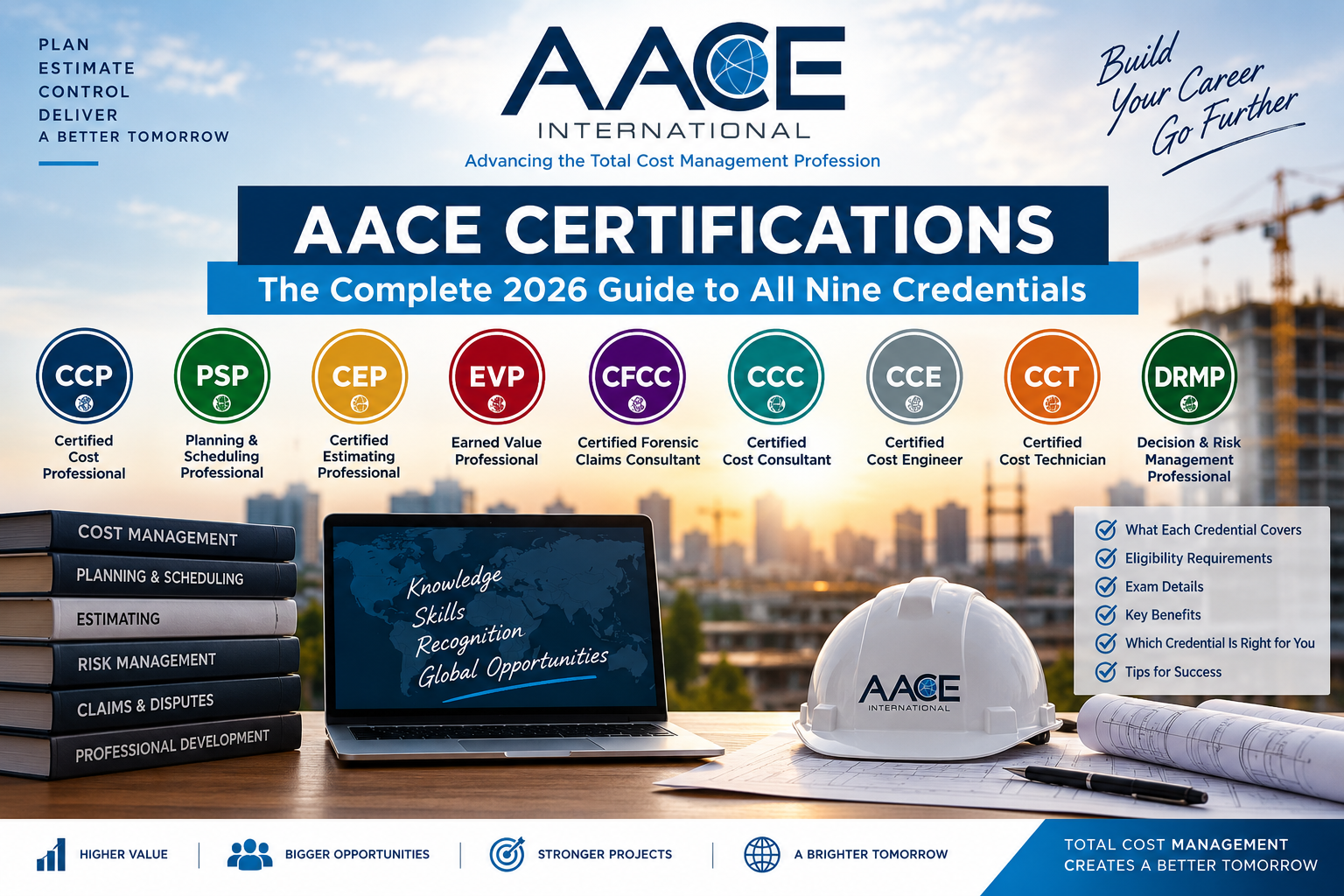
If you work in cost engineering, planning, scheduling, or claims, you have almost certainly run into the AACE alphabet soup. CCP. PSP. CEP. EVP. PRMP. CFCC. DRMP. Somebody on your project has two of them in their email signature, a recruiter told you that one of them would double your day rate, and a colleague swore that another one requires a technical paper that takes six months to write.
Some of that is true. A good deal of it is not.
I have spent more than twenty years in project controls, working across construction, infrastructure and heavy engineering, and I have watched capable engineers waste an entire year preparing for the wrong credential because the information they were working from was three revisions out of date. This guide exists to fix that. Every number in it — every fee, every question count, every eligibility rule — was pulled directly from AACE International's own certification pages on 4 September 2026, not from a competitor's blog and not from memory.
What follows is the complete map: all nine credentials, how the exams are actually built, what the application really asks of you, and how to work out which one belongs on your business card.
- ▸ AACE International offers nine certifications across three levels: technician (CCT, CST), professional (CCP, CEP, EVP, PSP, PRMP) and expertise (CFCC, DRMP).
- ▸ Professional-level exams cost US$525 for members and US$690 for non-members, with a US$260 resit fee. Membership is never required to sit an exam — it just costs you less.
- ▸ Eligibility for professional-level credentials is eight years of industry experience, or four years plus a four-year related degree.
- ▸ Both the CCP and the PSP run five hours, contain 119 multiple-choice and scenario questions, and finish with a written memo that most candidates never prepare for.
- ▸ You pass on a 70% average across all domains — which means you can fail individual domains outright and still walk away certified.
- ▸ Certification lasts three years and is maintained with 12 CEUs across at least two categories, or by re-examination.
Why reliable information about AACE exams is genuinely hard to find
Before the content itself, a short diagnosis — because if you have found this topic confusing, the confusion is not your fault.
AACE publishes precise, authoritative detail pages for each credential. They list exact question counts per domain, exact fees, exact scoring mechanics. They are excellent. And when I inspected them while preparing this article, I found that the detail pages for the CCP and the PSP both carry a noindex directive in their page headers, which instructs search engines not to list them in results.
The practical effect is significant. When you search for the structure of the CCP exam, the pages you are shown are all second-hand — training providers, exam-dump sites, and aggregators — because the primary source has effectively opted out of the results page. Some of those secondary sources are careful. Many are not, and several are recycling a version of the exam that no longer exists.
Here is what is still circulating widely, next to what AACE actually publishes today:
| Frequently repeated claim | What AACE currently states |
|---|---|
| The CCP contains 150 questions across four domains (Basic Skills, Economic Analysis, Project Management, Cost Estimating & Control) | The CCP contains 119 questions across six multiple-choice domains, plus a seventh Communication domain consisting of the memo |
| A technical paper is required for the CCP | There is no technical paper requirement in the current process |
| The PSP is cheaper than the CCP | Both carry identical fees: $525 member, $690 non-member, $260 resit |
| You must pass every domain individually | Passing is based on the average across domains, not on each domain |
| AACE membership is a prerequisite for certification | Membership is optional; it only reduces the exam fee |
Table 1 — Commonly repeated claims about AACE exams, against the current published position.
I mention all this not to score points against other websites, but because it changes how you should read anything on this subject — including this article. Check the date. Check whether the writer went to the source. Then check the source yourself before you pay a non-refundable fee.
What AACE International actually is
AACE International — the Association for the Advancement of Cost Engineering — was founded in 1956 and is headquartered in Fairmont, West Virginia. It is a member-driven non-profit professional society rather than a commercial examination vendor, which matters more than it sounds: its certification programme is accredited by the Council of Engineering and Scientific Specialty Boards (CESB), and its exam content is derived from a published body of knowledge rather than from a proprietary curriculum somebody is trying to sell you.
Three pillars of that body of knowledge are worth knowing by name, because the exams draw on all three:
- The Total Cost Management (TCM) Framework — AACE's process map describing how estimating, cost control, scheduling and risk interlock across the whole asset life cycle. It is the conceptual spine of the CCP.
- The Recommended Practices — a library of roughly 120 peer-reviewed technical documents that codify how specific methods should be applied. Some of these, such as 29R-03 on forensic schedule analysis and 18R-97 on estimate classification, have become de facto industry standards well beyond AACE membership.
- Skills & Knowledge of Cost Engineering — the reference text, currently in its 6th edition, that underpins most of the multiple-choice content.
All examinations are delivered through Kryterion, either at a physical testing centre or under online proctoring from your home or office. If you choose online proctoring, run the system check well before exam day rather than on the morning itself.
The nine credentials at a glance
AACE groups its certifications into three tiers. The tier tells you the seniority expected; the credential within the tier tells you the discipline.
| Level | Code | Full name | Discipline focus |
|---|---|---|---|
| 1 — Technician | CCT | Certified Cost Technician | Cost fundamentals |
| 1 — Technician | CST | Certified Scheduling Technician | Scheduling fundamentals |
| 2 — Professional | CCP | Certified Cost Professional | Total cost management (broadest) |
| 2 — Professional | CEP | Certified Estimating Professional | Cost estimating |
| 2 — Professional | EVP | Earned Value Professional | Earned value management |
| 2 — Professional | PSP | Planning & Scheduling Professional | Planning and scheduling |
| 2 — Professional | PRMP | Project Risk Management Professional | Project risk management |
| 3 — Expertise | CFCC | Certified Forensic Claims Consultant | Claims, disputes, forensic analysis |
| 3 — Expertise | DRMP | Decision & Risk Management Professional | Decision and risk analysis |
Table 2 — The nine AACE credentials by level, code and discipline focus.
Think of it as a funnel rather than a ladder. CCT feeds naturally into CCP. CST feeds into PSP. CEP, EVP and PSP are specialist credentials that sit alongside the CCP rather than beneath it — AACE describes the CCP as the umbrella credential that spans what the specialists cover individually. PRMP feeds into DRMP. CFCC stands slightly apart, aimed squarely at people who give evidence in disputes.
CCT → CCP · CST → PSP · PRMP → DRMP. CFCC sits apart, for practitioners who give evidence in disputes.
Figure 2 — Progression through the three AACE tiers.
Level 1 — technician certifications: CCT and CST
The two technician credentials exist for people who are early in their careers or who have moved into project controls from an adjacent discipline and want a formal marker of competence before they have accumulated the experience that professional-level certification demands.
Certified Cost Technician (CCT)
The CCT validates fundamental cost-engineering knowledge — cost elements, basic estimating, cost accounting concepts, and the vocabulary of the discipline. It is the natural first step for a cost engineer with two or three years behind them, and it pairs well with the early stages of the cost engineer career path.
Certified Scheduling Technician (CST)
The CST does the equivalent job on the scheduling side: network logic, activity definition, critical path fundamentals, and progress measurement. If you are a junior planner who wants something on your CV before you have eight years to your name, this is it — and the construction scheduler roadmap covers what to build alongside it.
Technician-level certifications are designed as stepping stones and are not renewable in the same way as professional credentials. They are intended to carry you until you qualify for CCP or PSP, not to be a permanent destination. Plan your progression accordingly — do not treat a CCT as a career endpoint.
Level 2 — professional certifications
This is where most of the industry's attention sits, and where the credentials actually move salaries. All five professional-level certifications share the same eligibility rule and the same fee structure, so the choice between them is purely about discipline.
▸ Certified Cost Professional (CCP)
The CCP is AACE's flagship. In construction, EPC, oil and gas, infrastructure and energy megaprojects it has become the benchmark credential for senior cost engineers, cost controllers and project controls leads, and it increasingly appears as a stated preference in owner and government procurement documents when a cost professional is being appointed.
Its scope is total cost management: estimating, cost control, economic analysis, performance measurement, and the interfaces with scheduling and risk. It is deliberately broad. That breadth is its value and also its difficulty — you cannot pass it by being excellent at one thing.
The exam runs to a maximum of five hours and contains 119 questions, a mixture of straightforward multiple-choice items and compound scenario questions that give you a situation and ask several linked questions about it. It is closed book, but on-screen formula sheets are provided, and you may bring any battery-operated calculator — the testing centre does not supply one.
| CCP domain | Questions | Share |
|---|---|---|
| Managing Project Costs | 43 | 36% |
| Interface with Other Disciplines | 28 | 24% |
| Conduct Performance Measurement / Analysis | 20 | 17% |
| Create Reports and Documentation | 13 | 11% |
| Inform the Risk Management Process | 9 | 8% |
| Support / Inform the Scheduling Process | 6 | 5% |
| Communication — one written memo assignment | — | Scored as a seventh domain |
| Total multiple-choice questions | 119 | 100% |
Table 3 — CCP domain structure and weighting.
Figure 3 — More than a third of the CCP paper sits in one domain.
Look at the distribution for a moment, because it is instructive. More than a third of the paper sits in a single domain. If your day job is cost control on a live project, you already have a substantial head start. If your background is scheduling, note that the scheduling domain is the smallest on the paper at six questions — the CCP is not a scheduling exam wearing a different hat.
▸ Planning & Scheduling Professional (PSP)
The PSP is the credential that carries most weight for planners and schedulers in construction, engineering and energy. It draws heavily on AACE Recommended Practice 14R-90, which defines the responsibilities and required skills of a planning and scheduling professional, and on the classic CPM literature.
Structurally it mirrors the CCP — same five hours, same 119 questions, same closed-book format, same memo at the end — but it collapses into just two multiple-choice domains.
| PSP domain | Questions | Share |
|---|---|---|
| Planning | 36 | 30% |
| Scheduling | 83 | 70% |
| Communication — one written memo assignment | — | Scored as a third domain |
| Total multiple-choice questions | 119 | 100% |
Table 4 — PSP domain structure and weighting.
Seventy per cent of the multiple-choice content is scheduling. That is a much narrower target than the CCP, and it is the single strongest argument for planners to take the PSP first rather than reaching straight for the flagship. It also means the memo carries proportionally more weight: with only three domains in the average, a poor memo drags your overall score harder than it would on the CCP's seven. If you are weighing the PSP against the PMI route, the PMI-SP exam guide covers the alternative in the same detail.
▸ Certified Estimating Professional (CEP)
The CEP is the specialist estimating credential — quantity development, pricing, estimate classification under RP 18R-97, contingency, and estimate review and validation. If you work in a dedicated estimating function rather than a broad controls role, the CEP is a sharper signal than the CCP and the study effort is more contained.
▸ Earned Value Professional (EVP)
The EVP is narrow and deep: earned value management as a discipline in its own right, including performance measurement baselines, variance analysis, EAC forecasting methods, and the governance around EVM systems. It is disproportionately valuable in defence, aerospace and government-funded work where EVM compliance is contractually mandated.
▸ Project Risk Management Professional (PRMP)
The PRMP covers risk identification, qualitative and quantitative analysis, and risk response planning at project level. It is the professional-tier entry point to the risk stream and feeds naturally into the DRMP at expertise level.
Level 3 — expertise certifications: CFCC and DRMP
The expertise tier is aimed at practitioners who are recognised as authorities and who are frequently asked to defend their analysis in front of somebody who is paid to dismantle it.
Certified Forensic Claims Consultant (CFCC)
The CFCC is the credential for people working in construction claims and disputes — entitlement analysis, delay and disruption quantification, damages, and expert testimony. If your working week involves phrases like "concurrent delay", "time impact analysis" and "but-for schedule", this is your endpoint. It pairs naturally with deep familiarity with Recommended Practice 29R-03, which sets out the nine Method Implementation Protocols for forensic schedule analysis and has been cited in tribunals worldwide. For the practitioner view of that work, see the delay analysis field guide and the delay analyst career path.
Decision & Risk Management Professional (DRMP)
The DRMP sits above the PRMP and moves from project-level risk process into decision analysis proper: probabilistic modelling, integrated cost and schedule risk analysis, decision trees, and the economics of choosing between capital options. It is the most quantitatively demanding credential in the family.
Eligibility, fees and the application process
For every professional-level certification, the eligibility rule is the same and it is short:
- Eight years of industry-related experience, or
- Four years of industry-related experience plus a four-year industry-related college degree, and
- Adherence to AACE's Canons of Ethics.
There is no prerequisite training course. AACE states this explicitly, and it is worth repeating because a number of commercial providers imply otherwise: you are never required to buy a course or a study guide from AACE, from its certification institute, or from any affiliated company in order to sit an examination. Many candidates find the official study guides genuinely useful, but they are a choice, not a gate.
| Item | AACE member | Non-member |
|---|---|---|
| Examination fee (professional level) | US$525 | US$690 |
| Resit fee | US$260 | US$260 |
| Refundable? | No — fees are non-refundable | No — fees are non-refundable |
| Includes | Eligibility review + computer-based testing | Eligibility review + computer-based testing |
Table 5 — Professional-level fees, verified 4 September 2026.
The arithmetic is straightforward: the $165 difference between member and non-member pricing is close to the cost of individual membership itself, which also unlocks complimentary access to several Recommended Practices. For most candidates, joining before applying is the cheaper route.
The part of the process that catches people out is not the fee — it is verification. Your experience must be verified by your employer using AACE's Employment Verification Form. A CV, a résumé or a job description submitted on its own is not accepted. And every document must be in English or accompanied by an official English translation. I have seen applications stall for weeks over exactly this, usually because a former employer in another country took a month to respond to a form nobody had warned them about.
AACE has, on occasion, suspended new applications for a particular credential while it resolves operational issues — this happened with the CCP during 2026. Application windows are not always open. Before you build a study plan around a target exam date, confirm on AACE's own certification page that applications for your credential are currently being accepted.
The 70% average — the scoring rule almost nobody explains properly
This deserves its own section because it is routinely misreported, and because understanding it correctly changes how you allocate your study time. You do not need to pass every domain. You need an overall average of 70% or higher across all domains, and the domains are averaged together to produce a single result. AACE publishes its own worked example for the PSP's three domains:
| Domain | Score | Domain outcome |
|---|---|---|
| Domain 1 | 75% | ✓ Pass |
| Domain 2 | 70% | ✓ Pass |
| Domain 3 | 65% | ✗ Fail |
| Average (75 + 70 + 65) ÷ 3 | 70% | ✓ Exam passed |
Table 6 — AACE's own worked scoring example: a failed domain did not sink the candidate.
A failed domain did not sink the candidate. That is the mechanic, and it has two consequences worth internalising. First, a catastrophic weakness in one area can be offset by genuine strength elsewhere — so do not panic-abandon an exam attempt because one topic frightens you. Second, and less comfortably, the fewer domains a credential has, the more each one matters. On the PSP, one weak domain out of three is a third of your average. On the CCP, one weak domain out of seven is far easier to absorb.
One more thing to set expectations: results are released on a pass or fail basis only. AACE does not give you your individual scores. If you fail, you will not be told which domain let you down, which makes honest self-assessment before the exam considerably more valuable than it would otherwise be.
The memo: the domain nobody prepares for
Both the CCP and the PSP finish with a Communication domain that consists of a single memo-writing assignment. You are given a scenario and a set of instructions, and you type your response into an on-screen text box.
In my experience this is the most underestimated part of either examination. Candidates spend months on formulas and network calculations, then arrive at the memo after four hours of multiple choice with no plan, no structure and a rapidly emptying tank. The memo is scored as a full domain — one of three on the PSP, one of seven on the CCP — so treating it as an afterthought is a measurable risk, not just an aesthetic one.
What the assessors are looking for is not literary quality. It is whether a working professional can take a defined situation, structure a response, reach a defensible position, and communicate it to a reader who was not in the room. That is exactly the skill a cost engineer or planner exercises when writing a variance narrative or an extension-of-time position paper.
AACE publishes an official guidance document titled "How to Write a CCP Memo". It is freely available from the CCP page and it is, in my view, the single most underused resource in the entire certification ecosystem. Read it early, not the week before.
✗ Common mistakes
These are the failure patterns I see most often, in roughly the order they cost people the most time and money.
1. Chasing the CCP when the PSP is the right credential
The CCP has more prestige in casual conversation, so planners gravitate toward it. But if you spend your working life in Primavera P6 building and defending schedules, the CCP asks you six scheduling questions out of 119. The PSP asks you eighty-three. Pick the exam that rewards the expertise you already have, then broaden later if you want to.
2. Studying from outdated blueprints
If your study guide, course or practice bank describes a four-domain, 150-question CCP, it predates the current structure. You will spend weeks preparing for weightings that no longer exist. Cross-check any material you buy against AACE's current published domain list before you start.
3. Leaving employment verification to the end
Applicants routinely finish their study plan and then discover that a former employer needs a month to sign a form. Start the verification process on day one of your preparation, not day ninety.
4. Ignoring the memo until the week before
Covered above, but it earns a second mention because it is the most avoidable failure mode in the whole process. Write three practice memos under timed conditions. Three is enough to build the reflex.
5. Treating "closed book" as "no support"
The CCP provides on-screen formula sheets. Candidates who spend hours memorising formulas they will be handed anyway are optimising the wrong variable. Spend that time on knowing which formula applies and why — which is what the scenario questions actually test.
6. Buying exam dumps
Beyond the ethics of it, which are covered by the Canons you must attest to, the practical problem is that dump content is scraped from old exam forms and is frequently wrong. You are paying to learn incorrect answers. AACE has itself issued vendor warnings on this point.
★ Expert tips
- Sit the exam that matches your last three years, not your next three. Certification validates experience you already have. Aspirational credentials are much harder and much less convincing on a CV than a credential you can actually talk about in an interview.
- Map the domain weightings onto a study calendar before you open a single book. Give Managing Project Costs roughly a third of your CCP preparation because it is roughly a third of the paper. Most candidates instead give equal time to unequal domains.
- Join AACE before applying. The member fee saving is close to the cost of membership, and membership brings complimentary access to Recommended Practices you would otherwise buy.
- Read the Recommended Practices for your discipline even if you never sit an exam. 14R-90 for planners, 18R-97 for estimators, 29R-03 for anyone touching delay analysis. They will make you better at your job independently of any credential.
- Run the Kryterion system check days in advance if you are testing online. A failed webcam or bandwidth check on the morning of a five-hour exam is an expensive way to learn this lesson, and the fee is non-refundable.
- Plan your five hours before you sit down. Roughly four hours for 119 questions leaves you around an hour for the memo. Decide that split in advance and hold to it, because the multiple-choice section will happily consume everything you give it.
AACE or PMI? Choosing between the two families
This question comes up constantly, usually framed as though one organisation must be better than the other. It is the wrong frame. They are optimised for different things.
| If your focus is… | AACE route | PMI equivalent |
|---|---|---|
| Cost engineering and control | CCP | No direct equivalent |
| Planning and scheduling | PSP | PMI-SP |
| Cost estimating | CEP | No direct equivalent |
| Earned value management | EVP | Covered within PMP only lightly |
| Project risk | PRMP → DRMP | PMI-RMP |
| Claims and disputes | CFCC | No equivalent |
| General project management | No direct equivalent | PMP |
Table 7 — AACE credentials mapped against their nearest PMI equivalents.
The honest summary: PMI credentials certify that you can manage a project. AACE credentials certify that you can control one. In construction, EPC, oil and gas and infrastructure — industries where the cost and schedule function is a distinct department with its own head count — AACE credentials carry more weight in that department, while the PMP remains the broader passport recognised outside it. Many senior project controls professionals hold one from each family, and that combination is genuinely more persuasive than two from the same one. If the PMP is the missing half for you, the first-attempt PMP guide is the companion to this article.
Where to go from here
If you are a cost engineer or a controls lead with eight years behind you, the CCP is your credential and Managing Project Costs is where a third of your preparation should go. If you are a planner, take the PSP first — seventy per cent of that paper is your day job. If you work in claims, the CFCC is the destination and Recommended Practice 29R-03 is the road to it.
Whichever you choose, do two things before you spend anything. Open AACE's own certification pages and confirm the current fees, domain structure and application status for yourself. And start the employment verification conversation with your employer today, because it will take longer than you think.
The credential is worth having. The preparation is worth doing properly. And the information you build that preparation on is worth checking twice. For the underlying vocabulary and formulas behind every domain above, the PMMilestone Encyclopedia A–Z covers each concept in reference depth, and the wider career guides library maps where each credential fits in a career.
All examination details, fees and eligibility requirements in this article were verified directly against AACE International's published certification pages on 4 September 2026. AACE updates these without prior notice — always confirm current details on the official site before applying.
Frequently Asked Questions
How many certifications does AACE International offer?
Nine, arranged in three levels. Technician level covers CCT and CST. Professional level covers CCP, CEP, EVP, PSP and PRMP. Expertise level covers CFCC and DRMP. The CCP is the broadest of the nine and is generally treated as the flagship credential.What is the difference between the CCP and the PSP?
Scope. The CCP covers total cost management broadly across six multiple-choice domains, with cost management taking the largest share. The PSP concentrates almost entirely on planning and scheduling, with 83 of its 119 questions in the scheduling domain alone. Fees, duration, eligibility and the memo requirement are identical.How much does an AACE certification exam cost?
Professional-level examinations cost US$525 for AACE members and US$690 for non-members, with a US$260 resit fee that applies to both. All fees are non-refundable and are due when you submit your application. The fee covers both the eligibility documentation review and the computer-based test.Do I need to be an AACE member to get certified?
No. Membership is not required to apply for or sit any AACE examination. It simply reduces the exam fee — by $165 at professional level — and gives you complimentary access to some study resources. Because the saving is close to the cost of membership itself, joining first is usually the economical choice.Can I pass the CCP if I fail one of the domains?
Yes. AACE averages your scores across all seven domains and you need an overall average of 70% or higher. Individual domain failures do not automatically fail the examination, provided your stronger domains lift the average to the threshold. Results are reported as pass or fail only, with no individual scores released.How long does an AACE certification last?
Professional-level certifications are valid for three years. To maintain one you must accumulate 12 Continuing Education Units across at least two different categories during that period, or re-sit the examination. Technician-level credentials work differently and are designed as temporary stepping stones toward professional certification.Is the CCP better than the PMP?
They certify different things, so neither is objectively better. The PMP validates general project management capability and is recognised across every industry. The CCP validates deep cost engineering and project controls expertise and carries most weight in construction, EPC, energy and infrastructure. Holding one from each family is a common and effective combination.What happens in the memo section of the CCP and PSP exams?
You are presented with a scenario and written instructions, and you compose a memo in response using an on-screen text box. It is scored as a full domain in its own right. AACE publishes an official guidance document called “How to Write a CCP Memo” that explains what assessors are looking for, and it is well worth reading early in your preparation.Can I take an AACE exam from home?
Yes. All AACE examinations are delivered by Kryterion and can be taken either at a physical testing centre or under online proctoring from home or office, provided your equipment meets the minimum technical requirements. Run the online system check several days before your exam date rather than on the morning itself.Is a technical paper required for the CCP?
No. That requirement belongs to an earlier version of the process and it still circulates widely on third-party sites. The current CCP process is an eligibility review followed by a five-hour computer-based examination that ends with the written memo assignment. There is no separate paper to submit.
People also ask
Follow-up questions practitioners search for next — each one points to the calculator, template or reference entry that answers it.
Which academy track maps to this career step?
Structured progression from planner to programme controls director. Project Controls Academy ↗
Which calculator should I learn first?
PV / EV / AC / CV / SV / CPI / SPI in one workbook — the gateway tool. EVM Calculator ↗
Which schedule tool will an interviewer expect me to know?
Runs the DCMA 14-point assessment against P6 / MS Project exports. Schedule Health Checker ↗
Where do I look up the terms in this guide?
Single-line definitions for 1,200+ project-management and controls terms. PM Glossary on PMMilestone.org ↗