How to Prepare a Recovery Schedule in Construction: A Planner's Step-by-Step Guide
A planner's field guide to recovery scheduling — how to measure the real gap, build an options register with the site team, test every lever against real resources, and submit a recovery programme the owner can actually believe.
By Dr. Hassan Eliwa, PhD — Founder of PMMilestone.org & PMMilestone.com · 2026-11-28
How to Prepare a Recovery Schedule in Construction: A Planner's Step-by-Step Guide
By Dr. Hassan Eliwa, PhD — Founder of PMMilestone.org & PMMilestone.com · Updated 2026-11-28 · https://pmmilestone.com/career-guides/how-to-prepare-recovery-schedule-construction
The recovery schedule that made things worse
The first recovery schedule I was ever asked to review looked perfect. A commercial tower was 41 working days behind its contractual completion date, the owner had issued a formal instruction to submit a recovery programme, and the contractor's planner had produced one in nine days. On paper, every one of those 41 days had been won back.
The trick was simple. Durations on the façade, the MEP risers and the fit-out floors had been cut by roughly a third, the working week had been changed from six days to seven, and three crews that did not yet exist had been added to the resource sheet. Nothing in the logic was wrong. Nothing in the file would fail a quality check. And none of it was going to happen.
Four months later the project was 58 working days late, the overtime bill had blown through the contingency, and the owner's team had stopped believing anything the contractor submitted. The recovery schedule had not recovered time. It had spent the one thing a late project cannot afford to lose: credibility.
I have prepared, reviewed or rebuilt recovery schedules on buildings, metro stations, utilities and industrial plants since then. This guide is the process I now use, and the one I teach planners who are about to face their first "submit a recovery programme within 14 days" letter.
Note on examples: the project stories in this guide are drawn from real assignments, with names, figures and identifying details changed or combined to protect clients. Contract references are general; always read the exact wording of your own contract.
What a recovery schedule is (and what it is not)
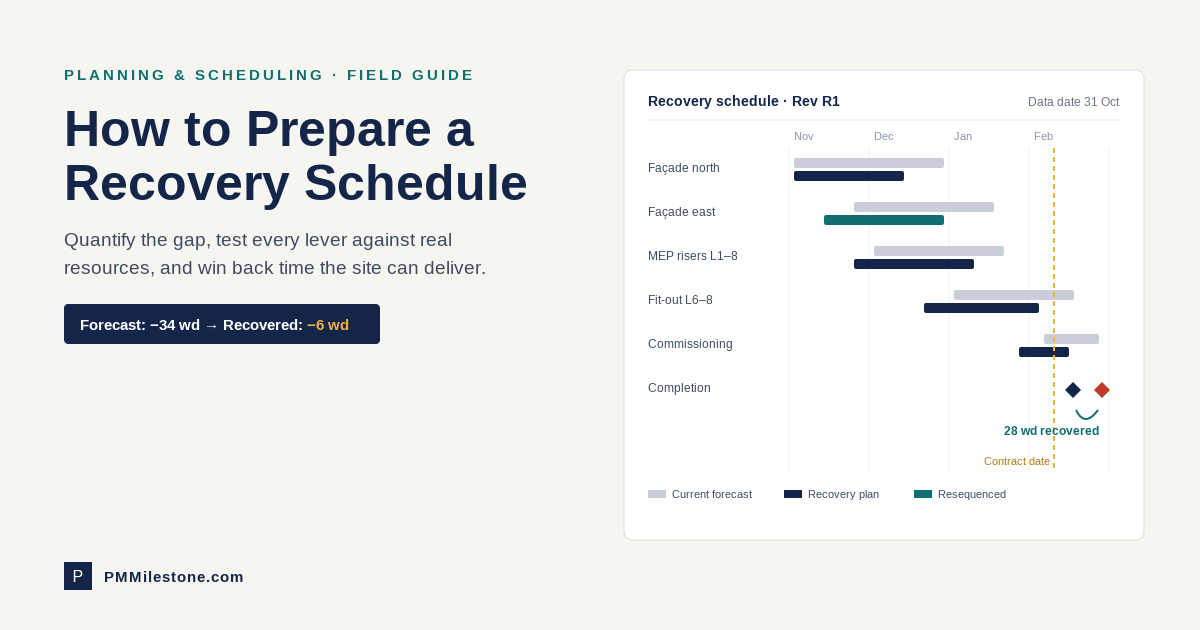
A recovery schedule is a version of the current, statused schedule that shows how the team intends to bring a late project back to an agreed completion date — or as close to it as is realistically possible — by changing how the remaining work will be done. It is a plan for the future, built from the truth of today.
AACE International's Recommended Practice 54R-07, Recovery Scheduling — As Applied in Engineering, Procurement, and Construction, treats it as a distinct deliverable with its own discipline, and the US GAO Schedule Assessment Guide includes strategies for recovery and acceleration as part of keeping a schedule reliable. In practice, people confuse it with three other things:
| Document | Purpose | Changes the completion date? |
|---|---|---|
| 📅 Monthly update | Records progress and forecasts completion using the current plan | Forecast only — it reports, it does not fix |
| 🛠️ Recovery schedule | Shows changed methods, sequence or resources to win back time | Pulls the forecast back towards the target |
| 📐 Revised baseline | Resets the measuring stick, usually after an agreed time extension or major change | Changes the agreed target itself |
| ⚡ Acceleration | A commercial and contractual event: completing earlier than you are otherwise entitled to | Depends on who instructed it and who pays |
That last row matters more than most planners realise. Mitigation — reasonable steps to limit the effect of a delay, usually at little or no extra cost — is something most contracts and delay protocols expect of a contractor anyway. Acceleration — spending real money to beat the date you are entitled to — is something somebody pays for. Your recovery schedule will sit right on that line, so it needs to be built with the contract open on the desk.
Why recovery scheduling is harder — and more scrutinised — in 2026
Three things have changed since I started doing this work.
⚙️ The reviewer has better tools than you used to. Owners and project management consultants now run every submission through automated schedule-quality and comparison tools before a human opens it. Shortened durations, added calendars, removed lags and new constraints are flagged in minutes. A recovery schedule that quietly squeezes durations without a stated basis is exposed almost immediately.
🤖 AI "what-if" engines make options cheap to generate. Optimisation tools in the ALICE and nPlan families, and general AI assistants given an XER and a good prompt, can produce dozens of resequenced scenarios in an afternoon. That is a genuine advance. It also means the scarce skill is no longer producing scenarios; it is judging which ones the site can actually build.
👷 Labour and supply chains are the real constraint. On most of the projects I see, the limiting factor is not logic — it is whether a second façade crew, an extra tower crane slot or a quicker switchgear delivery can actually be found. A recovery schedule that is not tested against real resource availability is a drawing, not a plan.
Before you touch the schedule: three questions
Most bad recovery schedules go wrong before the planner opens P6. I now refuse to start modelling until I have written answers to these three questions.
1. Is the current forecast actually true?
You cannot recover from a delay you have not measured properly. If the update has out-of-sequence progress, stale remaining durations, open ends or hard constraints holding dates in place, the "41 days late" figure may really be 25 — or 70. Fix the status first. Our guide to reading a P6 schedule in ten minutes is a quick way to triage it, and the guide to out-of-sequence progress in P6 explains why the scheduling option alone can move the critical path.
2. What caused the delay, and who owns it?
If the delay is the contractor's, recovery is usually the contractor's cost. If it was caused by the employer — late information, late access, changes — the contractor may be entitled to an extension of time rather than an obligation to recover. If it is a mix, you have concurrency to think about. Write a one-page cause summary, referenced to correspondence, before you model anything. Our delay analysis field guide covers the methods if you need to go deeper.
3. What does the contract say about recovery?
Standard forms deal with this differently, and the wording decides who pays:
- 📘 FIDIC (2017 Red, Yellow and Silver Books): Sub-Clause 8.7, Rate of Progress, allows the Engineer to instruct a revised programme and supporting report describing the methods the Contractor will use to expedite progress, where progress is too slow or has fallen behind and the delay is not one for which an extension of time is due. Where acceleration is instructed to reduce delays the Contractor is entitled to recover, the variation provisions are generally the route to payment.
- 📗 NEC4: acceleration is handled through clause 36 by agreement — the Project Manager may ask for a quotation to achieve an earlier date, and nothing changes unless the quotation is accepted. Revised programmes under clause 32 still have to show how the Contractor plans to deal with delays.
- 📙 JCT and bespoke forms: often say less, which pushes the question into notices, instructions and the general obligation to proceed regularly and diligently. Read them closely.
And watch for constructive acceleration: the situation where the owner refuses a valid time extension, insists on the original date, and the contractor accelerates to avoid liquidated damages. Whether that is recoverable varies a lot by jurisdiction, but the contractor's chances are far better when the recovery schedule and the cover letter clearly record that the work is being accelerated under protest and reserve the entitlement. For the entitlement side, see our guide to preparing an EOT claim that gets awarded.
The 7-step recovery schedule process
This is the routine I follow on every project, whether the gap is three weeks on a fit-out or six months on a plant.
- Step 1Freeze a clean update
- Step 2Quantify the gap
- Step 3Build an options register
- Step 4Test with real resources
- Step 5Model in a copy
- Step 6Stress-test the result
- Step 7Narrate & commit
Step 1 — Freeze a clean, validated status update
Copy the latest accepted (or submitted) update and give the copy a clear name such as PRJ-REC-R0. Fix status errors in the copy and log every correction. This R0 file is your "do-nothing" scenario: what happens if the team keeps working exactly as planned. Every recovered day you later claim is measured against it, so it must be defensible on its own.
Step 2 — Quantify the gap on the paths that matter
Write down three numbers: the forecast completion, the target date, and the gap in working days. Then do the step most people skip — list every path that is later than the target, not just the critical one. If the longest path is 34 days late but the second path is 29 days late and the third is 22, recovering the first path by 34 days gains you only 5 before path two takes over. I list paths by their float against the target date and plan recovery for the whole group.
- Path 1 · Façade → fit-out−34 wd
- Path 2 · MEP risers → commissioning−29 wd
- Path 3 · Switchgear delivery → energisation−22 wd
- Path 4 · External works−8 wd
Step 3 — Build an options register, not a wish list
Before changing a single activity, hold a two-hour workshop with the construction manager, the main subcontractors' supervisors, procurement and the commercial manager. Capture every recovery idea in a simple register: the option, the activities it affects, the working days it could save, the cost, the risk, the owner and what has to be true for it to work. The people who will build it are far better at spotting a realistic option than the planner is.
The levers usually fall into six families:
| Recovery lever | Typical cost | Main risk | Works best when… |
|---|---|---|---|
| 🔀 Resequencing / changing logic | 🟢 Low | Hidden physical constraints | Original logic was preferential, not physical |
| ⏩ Fast-tracking (overlapping) | 🟡 Low–medium | Rework, trade congestion | Work can be split into zones or floors |
| 👷 Adding crews / shifts | 🟠 Medium–high | Labour availability, supervision, workspace | Separate workfronts exist for the extra crews |
| ⏰ Overtime / extended calendars | 🔴 High | Productivity loss, fatigue, safety | Used for short, targeted bursts only |
| 🚚 Procurement expediting | 🟡 Variable | Supplier promises that do not hold | A long-lead item sits on the critical path |
| 🧩 Method or design change | 🟡 Variable | Approval time, quality | e.g. precast for in-situ, prefabricated risers |
Rank the options by cost per working day recovered and by risk. On almost every project I have worked on, the cheapest days came from resequencing and splitting work into zones, and the most expensive came from blanket overtime.
Step 4 — Test every option against real resources
This is the step that separates a recovery schedule from a hopeful one. For each option on the shortlist, ask:
- 👥 Who, by name? Which subcontractor has confirmed the extra crew, and from what date?
- 📐 Where will they work? Is there physical space for two crews on the same floor, or will they block each other?
- 🏗️ What do they share? Cranes, hoists, laydown areas, inspectors and access routes are often the real bottleneck.
- 📉 What happens to productivity? Industry research — from the Business Roundtable's early studies to later work by mechanical and electrical contractor associations — consistently shows that sustained scheduled overtime reduces productivity over time. A crew working 60 hours a week for two months does not deliver 50% more than one working 40.
Load the critical and near-critical activities with resources and look at the histograms. If the recovery plan needs 140 electricians in February and the subcontractor has never had more than 85 on site, you have found the plan's weak point before the owner does.
Step 5 — Model the options in a copy, one at a time
Create a working copy of R0 and apply options one at a time, re-scheduling after each, so you can record exactly how many days each one bought. Keep a change log as you go: activity ID, field changed, old value, new value, option reference. When you finish, you should be able to say "option 3, splitting Levels 6–8 fit-out into east and west zones, recovered 11 working days" and prove it.
A few modelling rules I hold to:
- ✅ Change durations only where the option justifies it, and record the basis (crew size, quantity, productivity rate).
- ✅ Use a separate, clearly named calendar for any extended working week, applied only to the activities it really affects.
- ✅ Do not add hard constraints to "hold" dates. If the logic does not deliver the date, the plan does not deliver it.
- ✅ Keep activity IDs from the update wherever possible, so the comparison stays readable.
Step 6 — Stress-test the recovered schedule
A recovery schedule tends to compress float across the whole programme. Run your normal quality checks — the DCMA-style metrics most reviewers use — and then look specifically at float distribution. If the original update had 15% of activities critical or near-critical and the recovery version has 55%, you have built a plan that any single hiccup will break.
Where the project is large enough to justify it, run a quick schedule risk analysis on both R0 and the recovery version. Showing the owner that the recovery plan moves the P50 completion forward, but also how much it narrows the margin for error, is one of the most persuasive things a planner can put on the table.
Step 7 — Write the recovery narrative and get real commitment
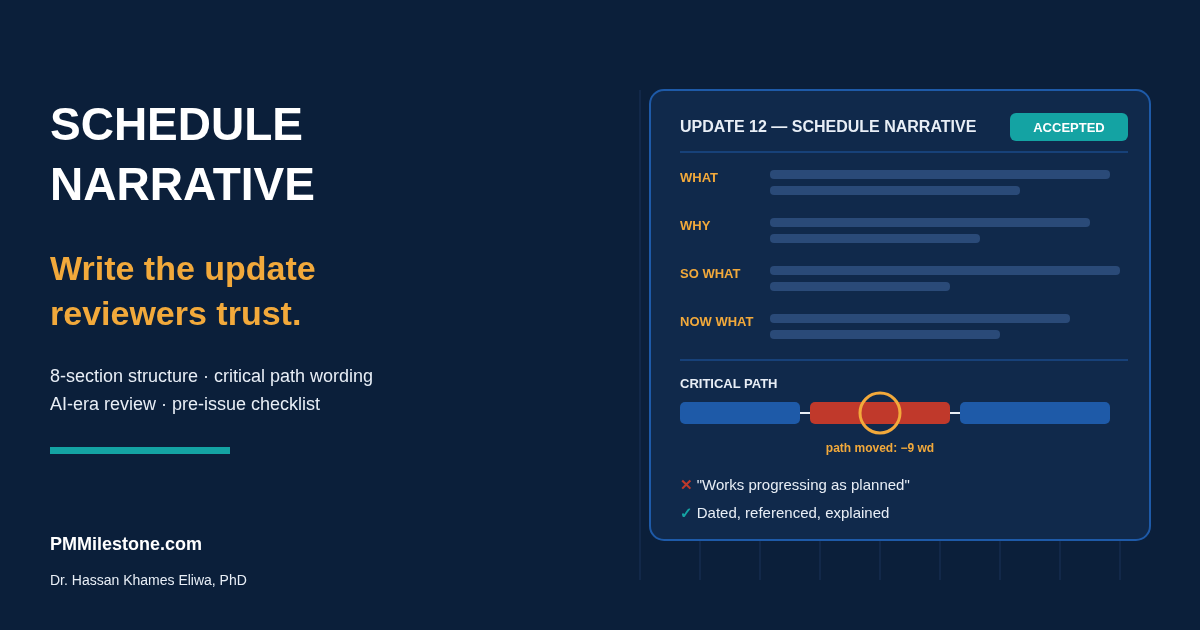
The schedule shows what will happen; the narrative explains why anyone should believe it. I keep it to a few pages: the current position (R0), the causes in brief, the target, each recovery measure with its days recovered, cost status, owner and start date, the resources confirmed, the risks and assumptions, and the decisions or approvals needed from the client. The same disciplines from our guide to writing a schedule narrative reviewers trust apply here — numbers, dates and references, not adjectives.
Then get the subcontractors to sign up to their parts in writing. A recovery schedule that the people doing the work have not agreed to is the planner's opinion, not the project's plan.
Real-world example: the metro station and the overtime trap
On an underground station box, the contractor was 30 working days behind on the structural works. The first recovery proposal moved the concrete and formwork crews from five ten-hour days to six twelve-hour days for four months. In the schedule, the 30 days disappeared.
In reality, productivity per hour dropped within about five weeks. Fatigue showed up in rework on the formwork, two near-miss incidents prompted a safety stand-down, and absenteeism climbed. After four months, the project had recovered roughly 8 working days at the cost of nearly all of its time-related contingency.
The second recovery plan, which I helped prepare, was very different: a dedicated second crew on the opposite end of the station box with its own pump and formwork set, a switch from in-situ to precast for the internal stair cores, and overtime limited to the weekend before each major pour. It recovered 19 working days over the next five months at a lower total cost than the first plan.
💡 Lesson learned: Overtime is a sprint tool, not a marathon tool. If your recovery plan relies on extended hours for more than a few weeks, model a productivity loss — or expect the site to model it for you.
Real-world example: the warehouse that recovered for almost nothing
A large logistics warehouse was 24 working days late after a wet winter delayed the ground-bearing slab. The original logic said: complete the whole slab, then erect the steel frame, then the roof, then the cladding.
In the options workshop, the steel erector pointed out that the frame could be erected bay by bay from pad foundations, with the slab poured in zones under the roof once each bay was weathertight. That one change — moving from a whole-building sequence to a zoned one — overlapped three trades that had been strictly consecutive. It also took the slab out of the weather.
The recovery version brought completion back by 21 working days. The cost was a modest increase in crane hire and some extra slab joint detailing. No overtime, no extra crews.
💡 Lesson learned: The cheapest recovered days are usually hidden in logic that was preferential rather than physical. Ask "does this really have to finish before that starts?" on every critical relationship — and ask the trades, not just the schedule.
Using AI and what-if tools the right way
I use optimisation and AI tools on recovery work, and they save real time. The skill is knowing which half of the job to give them.
| ✅ Let the tools do this | 🧠 Keep this for yourself |
|---|---|
| Generate alternative sequences and crew scenarios quickly | Decide which scenarios the site can physically build |
| Calculate days saved per option and rank them | Confirm crews, suppliers and access with real people |
| Compare R0 with the recovery version and list every change | Judge the contractual meaning of each change |
| Run quality checks and risk simulations | Explain the residual risk honestly to the client |
| Draft a first-pass summary of the options register | Write and sign the recovery narrative |
An optimiser does not know that the only available tower crane is already booked for the neighbouring core, or that the façade subcontractor's second crew is the same people currently working on another of your sites. Treat its output as a menu, not a plan.
Common mistakes (and what to do instead)
| ❌ Common mistake | ✅ What to do instead |
|---|---|
| Cutting durations with no stated basis | Tie every duration change to crew size, quantity and productivity |
| Recovering only the current critical path | Plan recovery for every path later than the target |
| Adding crews that nobody has confirmed | Name the subcontractor, the headcount and the start date |
| Long periods of planned overtime | Short targeted bursts; model productivity loss |
| Holding dates with hard constraints | Let logic drive dates; fix the logic if the date does not hold |
| Overwriting the update with the recovery version | Keep R0, recovery and change log as separate, named files |
| Calling it an "acceleration programme" by default | Agree the title and cover letter with your commercial team |
| Ignoring the cause of the delay | Record causes first; reserve entitlement where the delay is not yours |
| Submitting and walking away | Track each recovery measure weekly against its promised days |
My recovery schedule checklist
Before any recovery schedule leaves my desk, it has to pass this list.
- R0 "do-nothing" file is statused correctly and saved separately
- The gap is stated in working days against a clearly identified target date
- All paths later than the target are listed, not just the critical path
- Causes of delay are summarised and referenced; entitlement is reserved where relevant
- Each recovery measure shows days recovered, cost status, owner and start date
- Every duration change has a documented basis
- Resource histograms are within what subcontractors have confirmed in writing
- No new hard constraints; extended calendars applied only where justified
- Quality checks and float distribution reviewed; residual risk explained
- Change log between R0 and the recovery version is attached
- Title and cover letter agreed with the commercial manager
Practical lessons from years of recovering late projects
- Start early. Ten days of slippage recovered in month four is far cheaper than forty days recovered in month fourteen. Watch your float trend; our negative float case study shows how quickly erosion compounds.
- Under-promise by a margin. If the options add up to 30 days, I usually commit to 20–25 and hold the rest as a buffer. Hitting a promised date rebuilds trust faster than anything.
- Measure recovery weekly. Track each measure against the days it was meant to deliver. If a measure is not working by week three, replace it — do not wait for the monthly update.
- Know who owns the float you are using. Recovery often consumes float on non-critical paths. Under some contracts that matters commercially; see the float ownership guide.
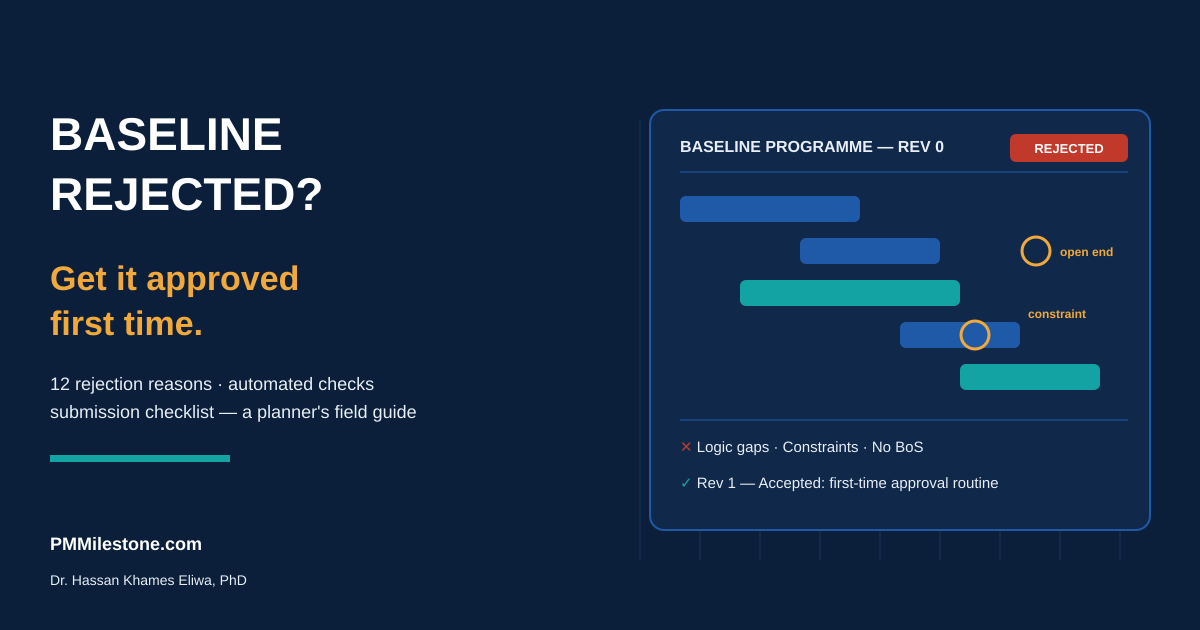
- Do not confuse recovery with re-baselining. If a time extension has been agreed, the right answer may be a revised baseline, not a recovery schedule. Our guide on getting a baseline approved first time applies equally to re-baselines.
- Keep the people who build it in the room. The best recovery ideas I have ever used came from foremen and subcontractor supervisors, not from the schedule.
❓ Frequently asked questions
What is a recovery schedule in construction?
A recovery schedule is a version of the current, statused schedule that shows how the project team will bring a late project back to an agreed completion date by changing the way the remaining work is done — for example by resequencing, adding crews, overlapping activities or expediting procurement. It is a forward-looking plan built from today's actual progress.How do I prepare a recovery schedule step by step?
Freeze a clean status update as a do-nothing file, quantify the gap on every late path, build an options register with the site team, test each option against real resources, model the options one at a time in a copy, stress-test the result for float and risk, and then write a recovery narrative with named owners and dates. Keep a change log between the original update and the recovery version.What is the difference between a recovery schedule and a revised baseline?
A recovery schedule tries to meet the existing target date by changing methods, sequence or resources. A revised baseline changes the target itself, usually after an extension of time or a major change has been agreed. If a time extension has been granted, a re-baseline may be the correct document instead of a recovery schedule.Is a recovery schedule the same as acceleration?
Not necessarily. Mitigation — reasonable steps to limit the effect of a delay — is generally expected of a contractor. Acceleration means completing earlier than the contractor is otherwise entitled to, usually at extra cost, and the question of who pays depends on the cause of delay and the contract. Agree the wording of your submission with your commercial team.What is constructive acceleration?
Constructive acceleration describes a situation where a contractor is entitled to more time but the owner refuses it and insists on the original date, so the contractor accelerates to avoid liquidated damages. Whether the cost is recoverable depends heavily on the contract and jurisdiction, so record clearly that the work is being accelerated under protest and seek contractual or legal advice.Which schedule compression technique is cheapest: crashing or fast-tracking?
Fast-tracking and resequencing are usually cheaper because they change the order or overlap of work rather than adding resources, although they can add rework and congestion risk. Crashing — adding crews, shifts or overtime — tends to cost more and suffers from diminishing returns, especially when overtime is sustained for long periods.How long should it take to prepare a recovery schedule?
It depends on the size of the project and on how clean the current update is. Many contracts give between one and four weeks once an instruction is issued. Most of the time should go into the options workshop and resource testing, not into editing the schedule file.Can AI tools prepare a recovery schedule for me?
AI and optimisation tools can generate and rank alternative sequences quickly, compare versions and run risk simulations. They cannot confirm that a crew exists, that a crane slot is free or that a supplier will deliver. Use them to produce options, then validate feasibility with the people who will build the work and sign off the plan yourself.
Written by Dr. Hassan Khames Eliwa, PhD — planning and project controls practitioner and founder of PMMilestone. The views and examples in this guide are based on professional experience and are provided for education; they are not legal advice. Always follow the requirements of your own contract and take commercial or legal advice where entitlement is in question.
People also ask
Follow-up questions practitioners search for next — each one points to the calculator, template or reference entry that answers it.
Which academy track maps to this career step?
Structured progression from planner to programme controls director. Project Controls Academy ↗
Which calculator should I learn first?
PV / EV / AC / CV / SV / CPI / SPI in one workbook — the gateway tool. EVM Calculator ↗
Which schedule tool will an interviewer expect me to know?
Runs the DCMA 14-point assessment against P6 / MS Project exports. Schedule Health Checker ↗
Where do I look up the terms in this guide?
Single-line definitions for 1,200+ project-management and controls terms. PM Glossary on PMMilestone.org ↗
More career guides
How to Write a Schedule Narrative That Reviewers Actually Trust
Why Your Baseline Schedule Gets Rejected — and How to Get It Approved on the First Submission