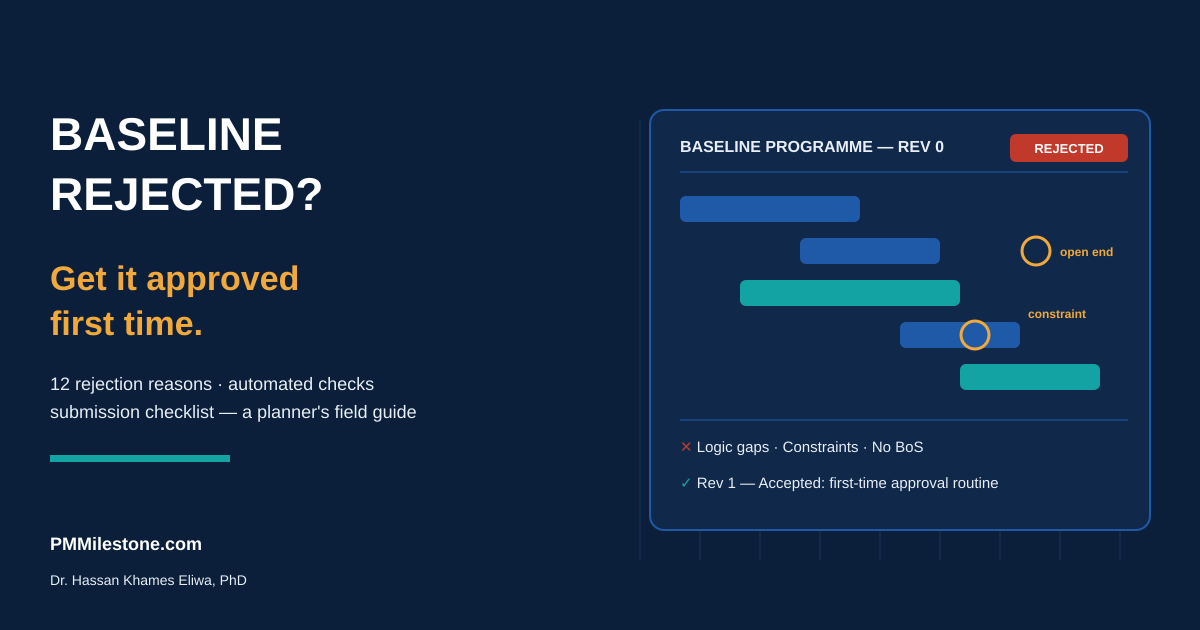
How to Write a Basis of Schedule (BoS) That Gets Your Baseline Approved: A Planner's Field Guide
A practical, section-by-section guide to the document that explains your baseline — what to put in a basis of schedule, how to source every duration, how to write an Exceptions Register reviewers accept, and the mistakes that send baselines back for resubmission.
By Dr. Hassan Eliwa, PhD — Founder of PMMilestone.org & PMMilestone.com · 2026-11-29
How to Write a Basis of Schedule (BoS) That Gets Your Baseline Approved: A Planner's Field Guide
By Dr. Hassan Eliwa, PhD — Founder of PMMilestone.org & PMMilestone.com · Updated 2026-11-29 · https://pmmilestone.com/career-guides/how-to-write-basis-of-schedule-document
The baseline that was fine — and still got rejected
A few years ago I reviewed a baseline for a hospital extension that was, technically, one of the cleanest files I had seen that year. Logic was complete, there were almost no hard constraints, the critical path ran sensibly from piling through the structure, envelope, MEP and commissioning. It passed every automated quality check the owner's team ran.
It was rejected anyway. Twice.
The rejection letters said the same thing in slightly different words: "The basis for activity durations is not demonstrated. The rationale for the 6-day calendar applied to structural works is not provided. Lags on activities A1240 to A1310 are not justified." The planner had done the work. He just had not written it down. The owner's reviewer had no way to tell a well-reasoned 18-day duration from a guess, so he did the only thing a careful reviewer can do — he sent it back.
The third submission contained almost exactly the same schedule. What changed was a 14-page basis of schedule document. It was approved in nine days.
That experience is the reason I now tell every planner I mentor the same thing: the schedule is the model; the basis of schedule is the argument. This guide is how I write that argument.
Note on examples: the project stories in this guide are drawn from real assignments, with names, figures and identifying details changed or combined to protect clients. Always follow the exact wording of your own scheduling specification.
What a basis of schedule is (and what it is not)
A basis of schedule — also called a schedule basis memorandum, schedule basis document or baseline narrative — is the written record of how and why the schedule was built the way it was. It explains the scope the schedule covers, the execution strategy it models, where the durations came from, which calendars apply and why, what the logic assumes, and every place where the planner deliberately departed from normal good practice.
Two widely used references describe it in similar terms. AACE International's Recommended Practice 38R-06, Documenting the Schedule Basis, treats the schedule basis as a deliverable in its own right, and the US GAO Schedule Assessment Guide describes a basis document as a single document that defines the organisation of the schedule, describes the logic of the network, sets out the approach to resources and provides a basis for all the parameters used to calculate dates. GAO also calls it a living document — something that is maintained, not filed and forgotten.
People regularly confuse it with three other documents:
| Document | Answers the question | When it is written |
|---|---|---|
| 📝 Basis of schedule | "How was this plan built, and why should I believe it?" | With the baseline and every re-baseline |
| 📅 Monthly schedule narrative | "What happened this period, and what changed?" | With every update |
| 💰 Basis of estimate | "How was the cost built?" | With the estimate |
| 📘 Method statement | "How will this specific operation be done safely?" | Before the work starts |
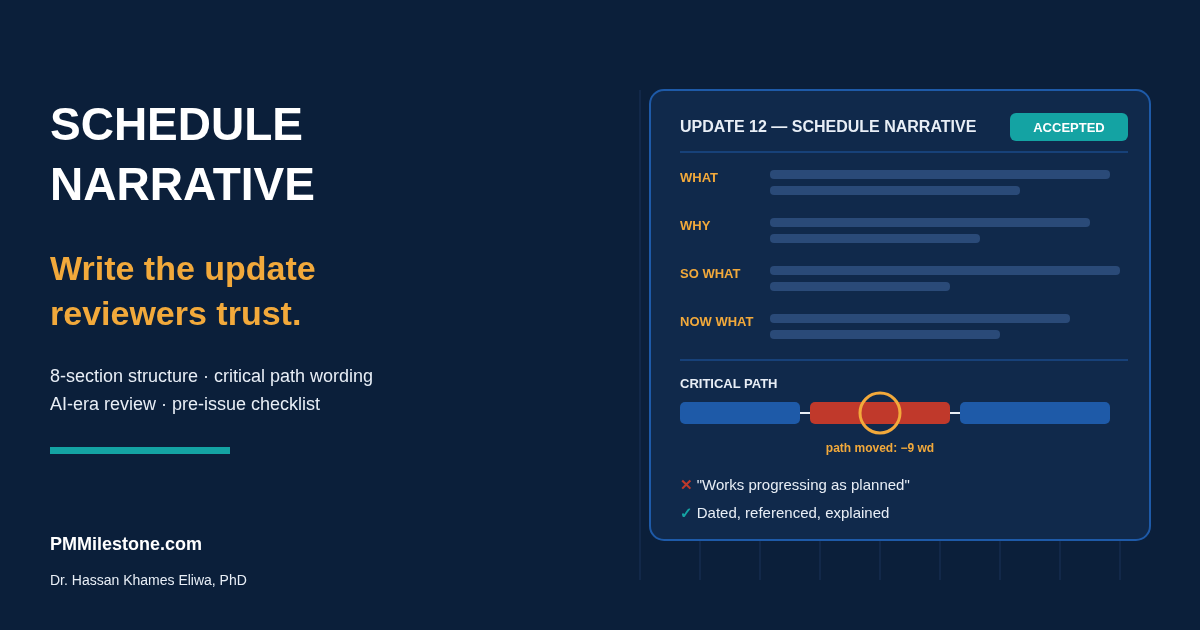
The basis of schedule borrows from the method statements and the estimate, and it feeds the monthly narrative. But it has a job none of them do: it makes the baseline auditable. If you want the narrative side done well too, our guide to writing a schedule narrative reviewers trust picks up where this one ends.
Why the BoS matters more in 2026 than it used to
⚙️ Every baseline is now machine-checked first. Owners and project management consultants routinely run submissions through automated schedule-quality tools before a person opens the file. Those tools flag lags, constraints, long durations and open ends in minutes. They cannot tell whether a flagged item is a mistake or a deliberate, sensible decision. Only your basis of schedule can.
🤖 AI reviewers read documents, not intentions. More review teams now ask an AI assistant to compare the schedule against the specification and the basis document and list inconsistencies. If the BoS says "five-day calendar" and the structural activities are on a six-day calendar, that mismatch will be found — quickly.
⚖️ The baseline is the reference point for every later claim. When a delay is analysed two years later, the first question is what the contractor planned and on what assumptions. A clear BoS is the cheapest delay-claim insurance a contractor can buy. Our delay analysis field guide shows how often the argument comes back to the original planning assumptions.
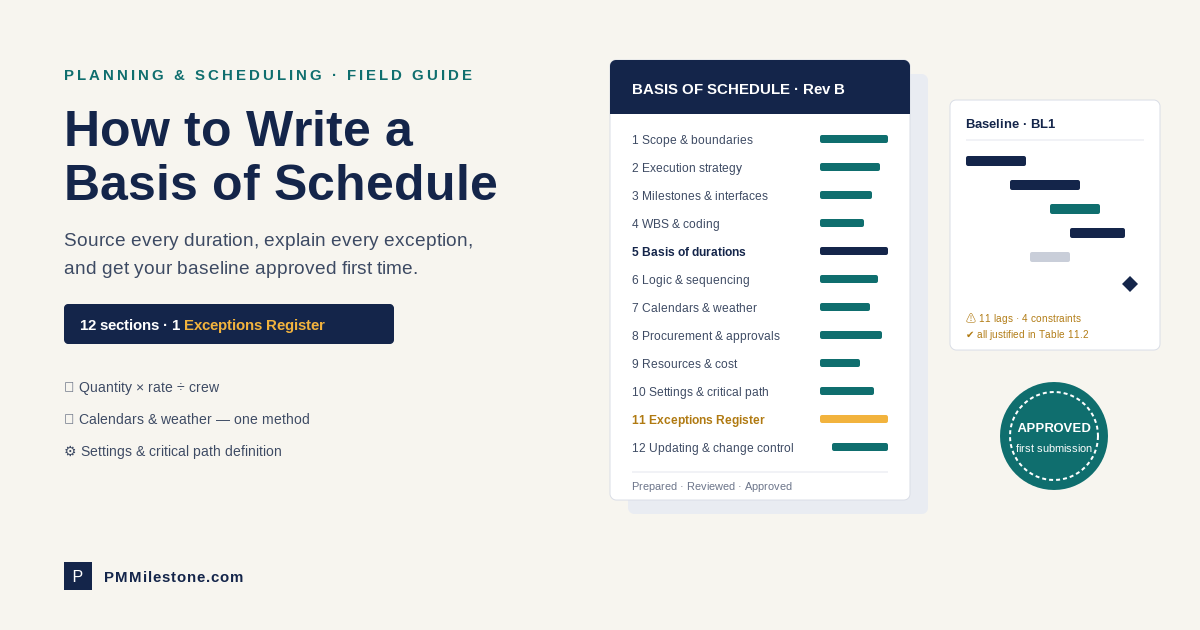
The 12-section basis of schedule outline I use
This is the outline I start from on every project. It lines up closely with the content categories commonly associated with AACE RP 38R-06 and with the GAO basis document guidance, but it is arranged in the order a reviewer actually reads. Not every project needs every section at the same depth — a three-month fit-out does not need the same document as a power plant — but every heading should at least be considered.
- Section 1Project overview & scope
- Section 2Execution strategy
- Section 3Milestones & interfaces
- Section 4Structure, WBS & coding
- Section 5Basis of durations
- Section 6Logic & sequencing
- Section 7Calendars & weather
- Section 8Procurement & approvals
- Section 9Resources & cost loading
- Section 10Settings & critical path
- Section 11Risks, assumptions & Exceptions Register
- Section 12Updating & change control
Section 1 — Project overview and scope
One page, no more. What is being built, where, for whom, under which contract, and between which contractual dates. Most importantly, state the boundaries: what the schedule includes and what it deliberately does not. "Owner-supplied furniture is shown as a single milestone; its installation is excluded" saves an argument later.
Section 2 — Execution strategy
Describe how the job will actually be built: phasing, zoning, the direction of work, major temporary works, crane strategy, self-performed versus subcontracted packages. A reviewer who understands that the structure goes up in two zones, east then west, will understand your logic before he opens it.
Section 3 — Milestones and interfaces
List every contractual milestone with its source clause, and every interface with others: utilities, neighbouring contractors, authority inspections, owner-furnished items, access dates. Note which ones are dates you control and which ones are dates you depend on.
Section 4 — Schedule structure, WBS and coding
Explain the WBS, the activity ID convention, the activity codes and any user-defined fields. A short table mapping each code to its purpose is enough. If the reviewer needs to filter by area or by trade, this is where you tell them how.
Section 5 — Basis of durations (the section reviewers read first)
This is the heart of the document and the section that gets baselines rejected. Every significant duration should trace back to one of a small number of sources, and the BoS should say which. I use a simple hierarchy:
| Duration source | Strength | Example wording in the BoS |
|---|---|---|
| 📐 Quantity × productivity ÷ crew | 🟢 Strongest | "Level 3 slab: 1,240 m² at 85 m²/crew-day, two crews = 7.3 days, rounded to 8." |
| 🤝 Subcontractor commitment | 🟢 Strong | "Façade durations per subcontractor programme Rev C dated 14 March." |
| 🚚 Supplier quotation | 🟢 Strong | "Switchgear 22 weeks ex-works per quotation Q-0417, plus 3 weeks shipping." |
| 📊 Historical project data | 🟡 Good if referenced | "Based on actual MEP first-fix rates on Project X, adjusted +10% for ceiling height." |
| 🏛️ Contract or authority period | 🟢 Fixed | "Engineer's review period 14 days per Specification 01 32 16, clause 3.4." |
| 🧠 Planner's judgement | 🔴 Weak alone | Only acceptable for minor activities — and say who agreed it. |
You do not need to justify all 2,000 activities individually. Group them: "All internal partition activities use the rates in Appendix B." Then list the critical and near-critical activities separately with their specific basis. That is where the reviewer's attention — and any later dispute — will be.
Section 6 — Logic and sequencing
State the sequencing philosophy and, crucially, separate physical logic (the slab must cure before it is loaded) from preferential logic (we choose to finish Level 2 before starting Level 3 to keep one crew together). That distinction matters enormously later: preferential logic can be changed to recover time, and it is often the first thing argued over in a delay claim.
Section 7 — Calendars and weather
List each calendar, what it applies to and why. Working days, hours, shifts, public holidays, shutdown periods, noise or night-work restrictions. Then state how weather is treated: built into durations, modelled as non-working days on a weather calendar, or covered by a contingency. Pick one approach and say so clearly — mixing them silently is one of the most common reasons time-related claims get messy.
Section 8 — Procurement, submittals and approvals
Long-lead items, their sources, and the submittal and review cycles that precede them. In my experience, missing or unrealistic approval durations are behind a large share of early slippage on building projects. If the contract gives the engineer 14 days to review and you have shown 7, the reviewer will notice.
Section 9 — Resources and cost loading
If the schedule is resource- or cost-loaded, explain how: which resources, which rates, how they reconcile to the estimate or the contract sum, and what the peak demand looks like. A one-line statement such as "peak electrical labour of 85 in month 14, confirmed as achievable by the subcontractor" answers a question before it is asked.
Section 10 — Scheduling settings and critical path definition
Planners skip this section more than any other, and it is the one that most often explains a "mysterious" difference between the contractor's dates and the owner's. Record the scheduling options used: retained logic or progress override, how total float is calculated, the definition of critical (longest path, or total float below a threshold), and whether open-ended activities are permitted. Our guide to out-of-sequence progress in P6 shows how one checkbox can move a forecast by weeks — which is exactly why it belongs in the BoS.
Section 11 — Risks, assumptions and the Exceptions Register
Write down the assumptions the plan depends on ("site access to Zone B by 1 June", "no ground contamination beyond the survey") and the key schedule risks. If a quantitative schedule risk analysis was run, summarise the result and any contingency held.
Then add the part that, more than anything else, changes how a reviewer reacts to your file: the Exceptions Register.
Section 12 — Updating and change control
How often the schedule will be updated, the data date convention, who statuses what, how changes to logic or durations are logged, and when a re-baseline will be proposed. This section tells the owner how the baseline will stay honest after approval.
The Exceptions Register: turning red flags into decisions
Automated quality checks — the DCMA 14-point assessment and its descendants — will always find something. A lag, a start-no-earlier-than constraint on an access date, a 45-day activity for a long-lead delivery. Those findings are not automatically errors. They become errors when nobody explains them.
An Exceptions Register is a short table that lists every deliberate departure from the usual checks, with the reason. Here is the format I use:
| Activity ID | Check flagged | Reason | Reference |
|---|---|---|---|
| A1020 | ⛔ SNET constraint | Contractual access date to Zone B | Contract Particulars, Item 7 |
| A2310 | ⏳ Lag 7 days | Concrete strength gain before stressing | Structural spec, clause 5.2 |
| P4010 | 📏 Duration > 44 days | Transformer manufacture; supplier lead time | Quotation Q-0417 |
| M9990 | 🔓 No successor | Project completion milestone | — |
If you want to see the wider list of reasons baselines fail, our guide to why baseline schedules get rejected covers the twelve I see most often — a missing or weak basis of schedule is high on that list.
Real-world example: the weather calendar nobody explained
On a highway interchange project, the contractor's baseline used a weather calendar that removed 18 working days a year from earthworks and paving. Sensible. But the BoS said nothing about it, and the durations for the same activities had also been padded by around 10% "for weather".
Nobody noticed at approval. Eighteen months later, during a wet season, the contractor submitted an extension of time claim for exceptional rainfall. The owner's delay expert pointed out — correctly — that weather was allowed for twice in the baseline, and that the contractor could not show which allowance had been used up. The claim that eventually settled was a fraction of the one submitted.
💡 Lesson learned: Choose one method for weather — calendar, duration allowance or contingency — and write it into the BoS with the data source (for example, ten years of local rainfall records). An unexplained weather allowance helps nobody when it matters.
Real-world example: the BoS that saved a re-baseline
On a water treatment plant, the owner instructed a significant scope change in month nine. The contractor had to re-baseline. Because the original BoS recorded the productivity rates, crew sizes and calendars behind every critical activity, the planner could show exactly which assumptions the change affected and which it did not.
The owner's team accepted the re-baseline after one round of comments. The reviewer told me afterwards that it was the first re-baseline on their programme where he had not had to ask "where did this number come from?" even once.
💡 Lesson learned: A good basis of schedule pays you back twice — at baseline approval, and again every time the plan has to change. Write it as if you will need to defend it in month nine, because you probably will.
How to write the BoS in practice: my routine
The order you write it in matters. I do not leave it until the schedule is "finished". By then the reasons behind half the decisions have been forgotten.
- Week 1Open the BoS file with the outline
- WorkshopsLog decisions as they are made
- DurationsRecord source per activity group
- Quality checkBuild the Exceptions Register
- SubmissionReview, sign & issue together
- 📂 Start the document on day one. Create the file with the twelve headings before you create the first activity. Fill it as you go.
- 🗣️ Capture decisions in the planning workshops. When the construction manager says "we'll do the east core first because the crane can reach it", that sentence belongs in Section 2 and Section 6 — write it down there and then.
- 📏 Keep a duration register. A simple spreadsheet with activity group, quantity, rate, crew, source and agreed-by. It becomes Appendix B.
- 🔍 Run the checks, then write the exceptions. Never the other way round.
- ✍️ Get the people who own the assumptions to sign. The construction manager and the main subcontractors should review the sections that describe their work. A BoS signed only by the planner is the planner's opinion.
Using AI to help — without letting it invent your basis
I do use AI assistants on basis documents, and they help. They are good at producing a consistent outline, turning workshop notes into clear prose, and — most usefully — cross-checking the BoS against an exported schedule to find mismatches: a calendar described one way and applied another, a lag listed in the file but missing from the register.
What they must never do is supply the basis. A productivity rate that an AI tool suggested, with no project source behind it, is exactly the kind of unsupported number a reviewer — or an opposing expert — will pull apart. The rule I follow: AI can write the sentences; the numbers and the reasons come from the project team. If you are building that kind of workflow, our guide to building an AI project manager covers the guardrails in more detail.
Common mistakes (and what to do instead)
| ❌ Common mistake | ✅ What to do instead |
|---|---|
| Writing the BoS in the last two days before submission | Open it on day one and record decisions as they are made |
| "Durations are based on experience" | Quantity, rate, crew and source — at least for every critical and near-critical activity |
| Copying a BoS from a previous project | Reuse the outline, never the content; reviewers spot another project's name quickly |
| Leaving out scheduling settings | Record retained logic / progress override, float calculation and critical path definition |
| Allowing for weather twice (calendar and durations) | Choose one method and state the data source |
| No explanation for lags and constraints | An Exceptions Register referencing every flagged item |
| Mixing physical and preferential logic without saying so | Label preferential logic clearly in Section 6 |
| A 60-page document nobody reads | 10–20 pages of substance, with detail in appendices |
| Never revising it after approval | Issue a new revision with every re-baseline and reference it in the monthly narrative |
My basis of schedule checklist
Before a BoS leaves my desk, it has to pass this list.
- Scope boundaries and exclusions stated in plain language
- Execution strategy explains phasing, zoning and major temporary works
- Every contractual milestone listed with its source clause
- Critical and near-critical durations each have a named source
- Preferential logic identified separately from physical logic
- Each calendar described, with one stated method for weather
- Submittal and review periods match the contract
- Scheduling settings and critical path definition recorded
- Exceptions Register covers every lag, constraint, open end and long duration flagged
- Assumptions and key risks listed, with contingency if held
- Reviewed by the construction manager and key subcontractors; revision and date shown
Practical lessons from writing and reviewing basis documents
- Write for the hostile reader. The friendly reviewer will approve a good schedule anyway. The BoS is for the person reading it in a dispute three years from now.
- Short and referenced beats long and vague. The best basis documents I have reviewed were 12 to 18 pages with strong appendices. The worst were 70 pages of generic text.
- Numbers, dates and references — not adjectives. "Realistic", "achievable" and "industry standard" mean nothing to a reviewer. "85 m² per crew-day, per Project X actuals" means something.
- Float and terminal float deserve a sentence. If the baseline finishes before the contract date, say so and say how that float is treated. Our float ownership guide explains why this matters commercially.
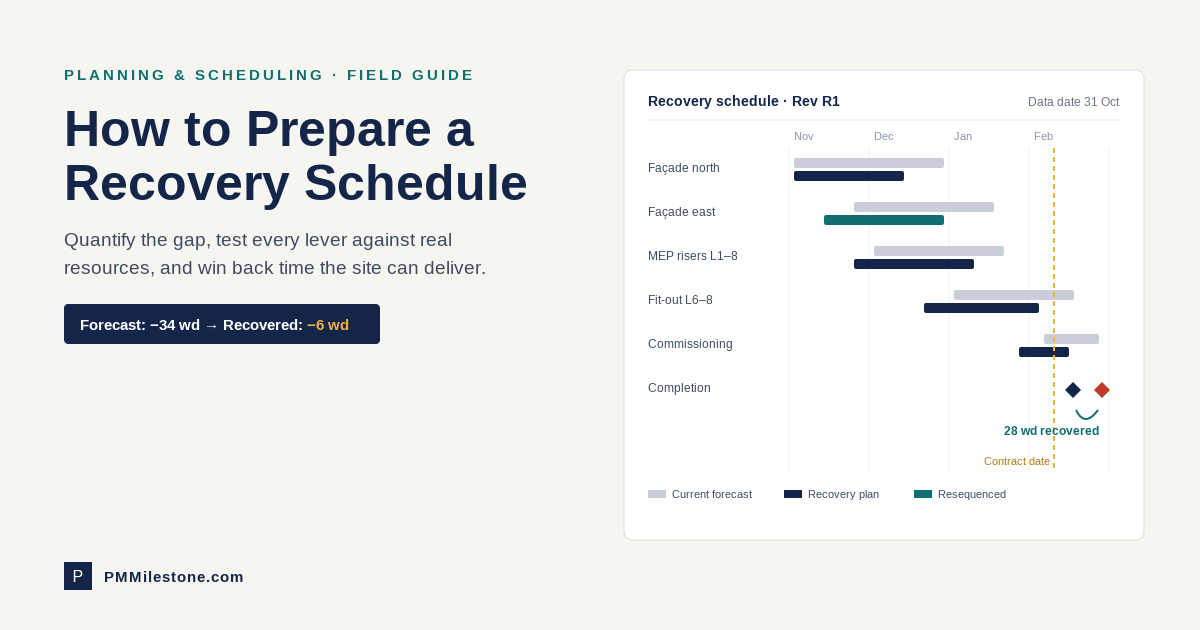
- Link the BoS to everything that follows. Every monthly narrative should say which BoS revision the update is measured against. When a recovery schedule is needed, the BoS tells you which logic is preferential and can be changed — see our guide to preparing a recovery schedule.
❓ Frequently asked questions
What is a basis of schedule in construction?
A basis of schedule (BoS), also called a schedule basis memorandum or schedule basis document, is the written record of how and why a project schedule was built. It explains the scope covered, the execution strategy, where the activity durations came from, which calendars apply, the logic assumptions, the scheduling settings used and any deliberate exceptions to normal good practice, so that a reviewer can understand and verify the baseline.What should a basis of schedule document include?
A complete basis of schedule usually covers: project overview and scope boundaries; execution strategy; milestones and interfaces; schedule structure, WBS and coding; the basis of activity durations; logic and sequencing; calendars and weather treatment; procurement, submittals and approvals; resource and cost loading; scheduling settings and critical path definition; risks, assumptions and an Exceptions Register; and the updating and change control process.Is a basis of schedule the same as a schedule narrative?
No. The basis of schedule explains how the baseline was built and is issued with the baseline and each re-baseline. The schedule narrative is issued with each periodic update and explains progress, changes to the critical path and variances during that period. The narrative should reference the basis of schedule revision it is measured against.Which standards describe the basis of schedule?
AACE International Recommended Practice 38R-06, Documenting the Schedule Basis, and the US GAO Schedule Assessment Guide both describe the purpose and typical content of a schedule basis document. Many owners also set their own requirements in the project scheduling specification, which takes precedence for that project.How long should a basis of schedule be?
Length depends on project size and complexity, but for most building and infrastructure projects a 10 to 20 page document with supporting appendices — such as a duration register and an Exceptions Register — is enough. A short, well-referenced document is more useful to reviewers than a long generic one.What is an Exceptions Register in a basis of schedule?
An Exceptions Register is a table in the basis of schedule that lists every deliberate departure from standard schedule quality checks — such as lags, date constraints, open ends or activities with long durations — together with the reason and a reference for each. It shows the reviewer that flagged items are intentional decisions rather than errors.Do I need to justify every activity duration?
Not individually. Group routine activities and state the common basis, for example a set of productivity rates in an appendix. Critical and near-critical activities, long-lead procurement and any unusually short or long durations should have their own specific source, such as quantities and rates, subcontractor programmes or supplier quotations.Can AI write a basis of schedule?
AI tools can help structure the document, turn workshop notes into clear text and cross-check the basis against an exported schedule for inconsistencies. They should not supply the assumptions, productivity rates or durations themselves; those must come from the project team and be traceable to real sources, or the document will not stand up to review.
Written by Dr. Hassan Khames Eliwa, PhD — planning and project controls practitioner and founder of PMMilestone. The views and examples in this guide are based on professional experience and are provided for education; they are not legal or contractual advice. Always follow the scheduling specification and contract requirements of your own project.
People also ask
Follow-up questions practitioners search for next — each one points to the calculator, template or reference entry that answers it.
Which books deepen this career path?
Field handbooks on project controls, P6 scheduling and EVM. Books & Publications ↗
Which academy track maps to this career step?
Structured progression from planner to programme controls director. Project Controls Academy ↗
Which calculator should I learn first?
PV / EV / AC / CV / SV / CPI / SPI in one workbook — the gateway tool. EVM Calculator ↗
Which schedule tool will an interviewer expect me to know?
Runs the DCMA 14-point assessment against P6 / MS Project exports. Schedule Health Checker ↗
More career guides
How to Prepare a Recovery Schedule in Construction: A Planner's Step-by-Step Guide
How to Write a Schedule Narrative That Reviewers Actually Trust